My recommendation: give Gemini 4 Argon a clear deliverable, relevant evidence, and explicit boundaries before asking it to work through a complex task. A more capable reasoning model still needs to know what success looks like.
Google positions Argon for demanding, multi-step work, including software engineering and professional knowledge tasks. That makes the quality of the assignment worth paying attention to: an unclear objective can affect several connected steps.
My approach would be to write the prompt as a compact work brief. Define the result first. Then explain which information to use, which constraints matter, and how the answer should be presented.
ON THIS PAGE
Why a vague Argon prompt is hard to evaluate
The six-part brief I recommend
A complete prompt to copy
What a usable output looks like
Where this method stops helping
Why a Vague Argon Prompt Is Hard to Evaluate
Consider this request:
Use Gemini 4 Argon to analyze our onboarding and write a better email sequence.
The task sounds straightforward. But I would struggle to approve the answer without first resolving several questions.
Does “better” mean shorter emails, more completed connections, or more paid subscriptions? Can the sequence introduce features? Which product details are confirmed?
Argon might produce a coherent answer, but coherence is not the same as meeting your business requirements.
I would start with this sentence:
Draft three onboarding emails that help new users connect their first Google Analytics data source.
Now I know what the deliverable is and what action it should support.
The Six-Part Brief I Recommend
This is my editorial framework, not an official Argon prompt syntax.
Part | What to include | Example |
|---|---|---|
Task | The specific deliverable | Three onboarding emails |
Goal | The intended next action | Connect a first data source |
Context | Relevant audience and workflow details | Small marketing teams completing setup |
Evidence | Sources the answer may rely on | Verified product notes |
Boundaries | Claims or actions to avoid | No invented setup times |
Output | A reviewable structure | Subject, body, CTA, unresolved questions |
The evidence section deserves particular attention.
If you provide product documentation and customer feedback, explain their different roles. Documentation can establish supported features. Feedback can reveal confusion. A customer’s description of a feature does not automatically establish how that feature works.
My preference is to make that distinction explicit before asking for analysis.
A Complete Gemini 4 Argon Prompt to Copy
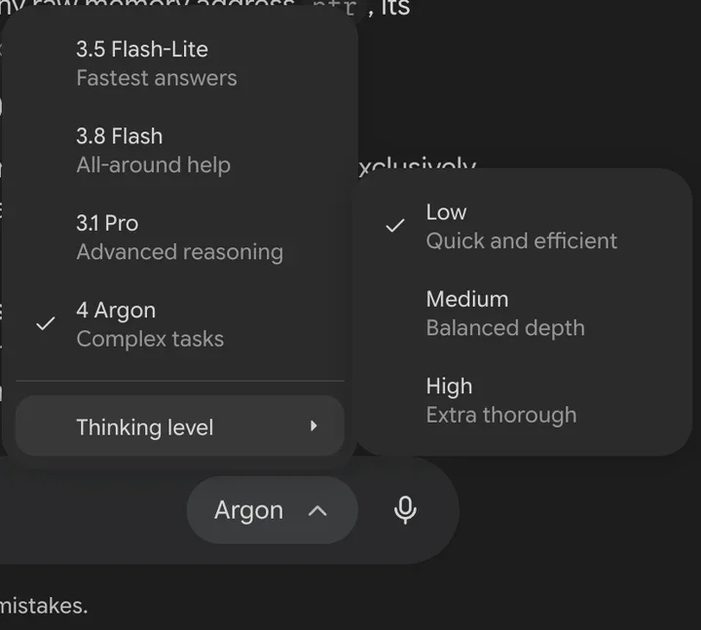
Select Argon in the interface you are using, then adapt this brief:
Task:
Draft three onboarding emails.

Goal:
Help new users connect their first Google Analytics data source.

Audience:
Marketing managers at small businesses who are comfortable
with spreadsheets but unfamiliar with analytics integrations.

Verified product notes:
- Connections begin in Settings > Data sources.
- Google Analytics is supported.
- Users review a permission request during connection.
- Users can disconnect a source from the same settings page.
- The exact permissions are not documented in these notes.

Requirements:
- Maximum 120 words per email body.
- One CTA per email.
- Use plain, friendly language.
- Do not invent setup times, performance results, or guarantees.
- Do not describe undocumented permissions.
- Make each email understandable independently.

Missing information:
Ask about missing facts that prevent an accurate draft.
List minor editorial assumptions separately.

Output:
1. Three emails, each with a subject, body, and CTA.
2. Product details requiring confirmation.

Put the deliverables first.
Keep explanatory commentary brief.
The three-email sequence has a maximum of 360 body words. That number defines the assignment; it does not establish an optimal email length.
I would also avoid treating available context capacity as a target. Include material because it changes the work, not because the model has room for it.
What a Usable Output Looks Like
The following comparison is illustrative. It is not an Argon benchmark or a recorded model response.
Before: Broad Claims and Competing Actions
Subject: Unlock your marketing potential
Connect all your tools in seconds, explore advanced insights, and invite your team to transform your results today.
CTA: Get started
I would reject this draft against our example brief.
“All your tools” and “in seconds” are unsupported. Exploring insights and inviting teammates distract from connecting the first source.
After: One Documented Next Step
Subject: Connect Google Analytics to your workspace
Start by opening Settings → Data sources and choosing Google Analytics.
Follow the connection steps and review the permission request before continuing. If you later decide to remove the connection, you can disconnect the source from the same settings page.
CTA: Connect Google Analytics
This draft is easier to inspect. Its instructions trace back to the fictional product notes, and its CTA matches the stated objective.
That does not prove it will improve activation. Measuring activation requires actual user data and an appropriate experiment.
Where This Method Stops Helping
A better Argon prompt cannot repair incorrect source material.
If the interface labels are outdated, the answer may repeat outdated instructions. If the real setup obstacle is unknown, an email sequence cannot establish it.
My recommendation is to judge the first draft against three questions:
Did it produce the requested deliverable?
Can its factual claims be supported?
Does it respect the boundaries?
Then edit the prose. That order keeps a polished answer from moving forward before the underlying work is sound.