LangChain makes it easy to wire Gemini into larger chains and agents. That convenience can also hide the places where control and observability matter most. This post shows how I connect Gemini to LangChain while keeping model choice, prompts, tool validation, and error handling visible and testable.
I use LangChain for orchestration, not as a reason to stop understanding the underlying calls. The patterns below reflect that preference. The goal is not to avoid LangChain; the goal is to use it without surrendering the ability to debug and control the Gemini-specific decisions.
Explicit Model Instantiation
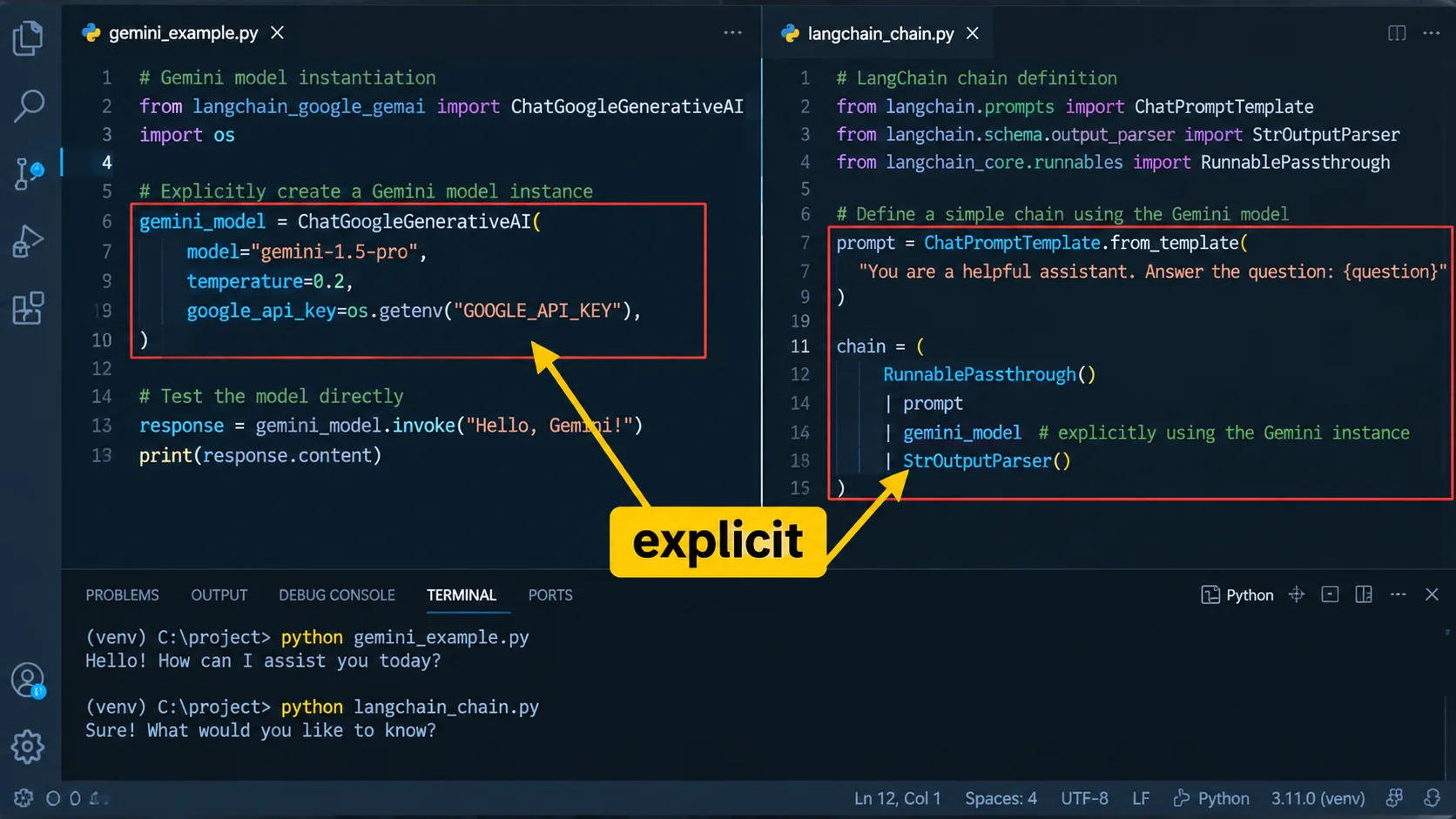
I never rely on a default model string buried inside a chain. The Gemini model is instantiated in one place with an explicit model name, temperature, and safety settings. That object is then passed into the LangChain wrapper.
This makes it trivial to swap Flash for Pro, or to pin a specific version, without hunting through chain definitions. It also makes it obvious in code review when someone changes the model. Hidden defaults are the enemy of both safety and intentional experimentation.
This is especially true when the foundation is shifting. Read up on rumors about the upcoming Gemini 4 model architecture so you know how your orchestration layers might need to adapt when the underlying models change.
I also keep the model name in a configuration object that is logged at startup. When a production issue appears weeks later, the logs show exactly which model version was running instead of requiring a code archaeological dig.
Prompts Live Outside the Chain
System prompts and tool descriptions are stored as separate, versioned text (or Python constants) rather than being constructed inside chain methods. When a prompt changes, the diff is obvious. When a chain fails, I can test the prompt in isolation with the raw Gemini client before debugging the LangChain layer.
This separation also makes A/B testing of prompts practical. I can point two otherwise identical chains at two different prompt files and compare outcomes without touching the orchestration code. The same separation makes it easier to hand a prompt to a colleague for review without forcing them to understand the full chain graph.
Tool Calls Still Validate
Even when LangChain handles the tool-calling loop, I keep a validation step before any tool is executed. The validation function is ordinary Python that checks names, required fields, and basic types. LangChain’s convenience does not remove the need for that check.
I also log the raw tool call proposed by the model and the validated version that was actually executed. The difference between the two is occasionally illuminating; it shows where the model is systematically imprecise and where the validation layer is doing real work.
Concern | How I keep it visible |
|---|---|
Model identity | Explicit instantiation, no defaults |
Prompt content | External, versioned files or constants |
Tool arguments | Validation function before execution |
Errors | Logged with model name and prompt hash |
Token usage | Extracted and recorded after every call |
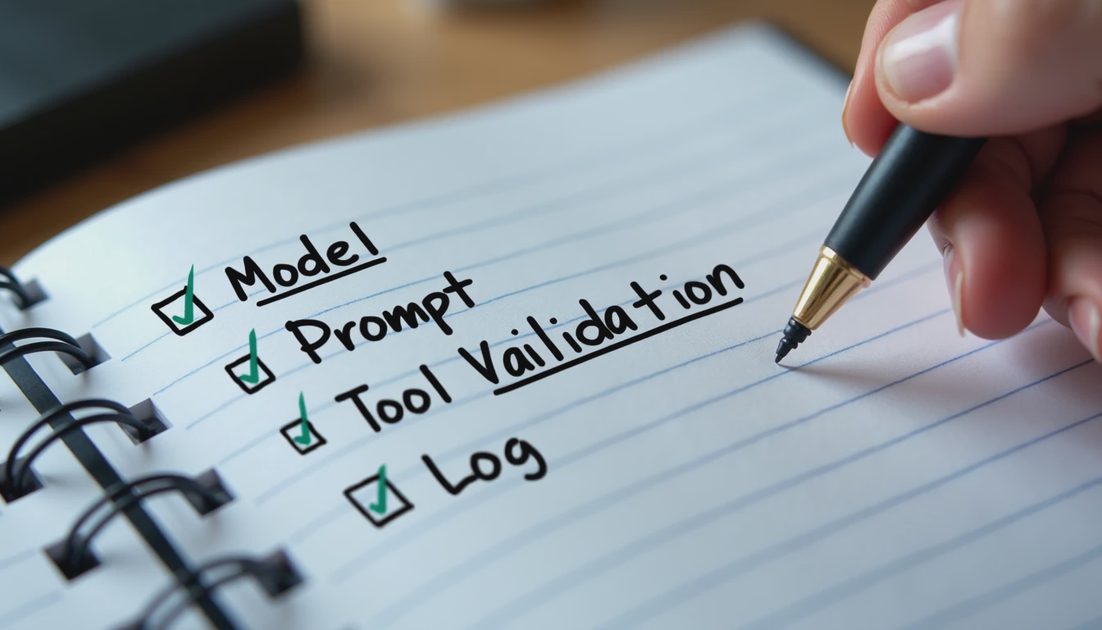
The table above is the checklist I use when reviewing any new LangChain + Gemini integration. If any row is missing, the integration is not ready.
What Worked / What Failed / What I Would Change
What worked
Keeping the Gemini client and prompts outside the deepest LangChain abstractions. Validating tool arguments in ordinary code. Logging enough context to replay a failed call. Explicit model instantiation that makes Flash-versus-Pro swaps a one-line change.
What failed
Early experiments that accepted LangChain’s default model and prompt construction. Debugging became slower and the surface area for accidental change grew. Also, relying on LangChain’s internal retry logic without recording the underlying Gemini error made some failures opaque.
What I would change in production
I would add a thin adapter layer that normalizes LangChain’s message format back to the raw Gemini request/response shape for logging. That would make it easier to compare behavior across different orchestration libraries later. I would also expose a configuration flag that disables LangChain’s higher-level agent loop so that simple chains can be tested in isolation.
I tried it first. You can use LangChain for the parts it is good at (orchestration, memory, tool routing) while still owning the parts that determine reliability. The demo is easy. Keeping the important decisions visible is the real work. Once those decisions are visible, LangChain becomes a useful accelerator instead of a source of hidden behavior.
The same principle applies to any orchestration library. Convenience is valuable. Invisible defaults and unlogged decisions are not. The patterns in this post are less about LangChain specifically and more about refusing to let convenience erase control. Teams that keep the important parts visible ship with more confidence and debug with less guesswork. That trade-off—slightly more explicit code in exchange for long-term clarity—has been worth it on every project where I applied it. The next time you reach for an orchestration library, decide in advance which decisions you still want to own, and keep those decisions in code you can read, test, and change without digging through layers of abstraction.
I also recommend writing a short “ownership map” for any new chain: which component owns the model choice, which owns the prompt, which owns tool validation, and which owns logging. When that map is clear, onboarding new engineers and debugging production issues both become faster. When it is missing, the convenience of the library turns into a source of hidden coupling.
The same principle applies when evaluating new orchestration features. Ask what the feature hides as well as what it automates. If the hidden parts include model selection, prompt content, or error handling, prefer an explicit implementation until the team has enough experience to own those decisions comfortably.