
Bottom line first.
If you write code every day, the difference between Gemini 4 Neon and Claude Fable 5.2 shows up less in the leaderboard and more in how each model behaves inside a normal coding loop.
Public data still holds:
Claude Fable 5.2 scores higher on pure intelligence (65 vs Neon’s 61 at top effort).
Gemini 4 Neon is significantly cheaper ($3/$15 vs $8/$40 per million tokens) and usually finishes tasks faster.
In practice, that means Neon is better for rapid iteration, while Fable 5.2 is more useful when the problem is ambiguous or the first few attempts keep missing the real issue.
The coding task I used
A small but realistic Python task:
Take this function that fetches user data, clean it up, add proper error handling, and write two unit tests.
Original messy starting code:
Python
import requests

def get_user(id):
    r = requests.get(f"https://api.example.com/users/{id}")
    data = r.json()
    return {
        "name": data["name"],
        "email": data["email"],
        "active": data["status"] == "active"
    }
This is the kind of code most of us actually inherit — short, a bit careless, and missing edge cases.
What Neon typically produces
Neon tends to move quickly and make focused improvements. A typical response looks like this:
Python
import requests
from typing import Dict, Any

def get_user(user_id: int) -> Dict[str, Any]:
    """Fetch a user and return a cleaned dictionary."""
    try:
        response = requests.get(
            f"https://api.example.com/users/{user_id}",
            timeout=5
        )
        response.raise_for_status()
        data = response.json()

        return {
            "name": data.get("name", "").strip(),
            "email": data.get("email", "").lower(),
            "active": data.get("status") == "active",
        }
    except requests.RequestException as e:
        raise RuntimeError(f"Failed to fetch user {user_id}: {e}") from e
And a simple test it often adds:
Python
import unittest
from unittest.mock import patch, Mock

class TestGetUser(unittest.TestCase):
    @patch("requests.get")
    def test_get_user_success(self, mock_get):
        mock_get.return_value = Mock(
            status_code=200,
            json=lambda: {"name": " Ada ", "email": "[email protected]", "status": "active"}
        )
        mock_get.return_value.raise_for_status = Mock()

        result = get_user(1)
        self.assertEqual(result["name"], "Ada")
        self.assertEqual(result["email"], "[email protected]")
        self.assertTrue(result["active"])
Personal note: Neon feels like a fast pair-programmer. It rarely rewrites the whole file for no reason. When I ask for small changes (“add a timeout”, “make the email lowercase”), it usually stays focused. That makes it pleasant for long interactive sessions.
What Fable 5.2 typically produces
Fable 5.2 often thinks a bit longer and surfaces more edge cases on the first try:
Python
import requests
from typing import TypedDict

class User(TypedDict):
    name: str
    email: str
    active: bool

def get_user(user_id: int) -> User:
    if not isinstance(user_id, int) or user_id <= 0:
        raise ValueError("user_id must be a positive integer")

    try:
        response = requests.get(
            f"https://api.example.com/users/{user_id}",
            timeout=5,
        )
        response.raise_for_status()
        data = response.json()
    except requests.Timeout as e:
        raise RuntimeError(f"Timeout while fetching user {user_id}") from e
    except requests.HTTPError as e:
        raise RuntimeError(f"HTTP error for user {user_id}: {e.response.status_code}") from e
    except requests.RequestException as e:
        raise RuntimeError(f"Network error for user {user_id}: {e}") from e

    name = (data.get("name") or "").strip()
    email = (data.get("email") or "").strip().lower()
    status = data.get("status")

    if not name or not email:
        raise ValueError(f"Incomplete user payload for id {user_id}")

    return {
        "name": name,
        "email": email,
        "active": status == "active",
    }
It also tends to write more thorough tests, including failure paths.
Personal note: Fable 5.2 feels more like a careful senior engineer. It often catches things I forgot to mention (invalid IDs, missing fields, different exception types). The downside is that it sometimes over-engineers simple requests, and the higher price becomes noticeable when you make many small follow-up asks.
Side-by-side feel in a real session
Situation | Neon | Fable 5.2 |
|---|---|---|
“Add a timeout and basic error handling” | Fast, clean, good enough | More complete, sometimes more code than needed |
“Write two unit tests” | Solid happy-path + one error case | More edge cases covered |
“This still fails when the API returns 404” | Quick surgical fix | Stronger diagnosis of the root cause |
12–15 back-and-forth turns | Stays cheap and responsive | Cost and latency add up |
Explaining the change | Clear and short | Usually more detailed |
Minimal API examples
Gemini 4 Neon (Google Gen AI SDK style)
Python
from google import genai

client = genai.Client()  # uses GEMINI_API_KEY

response = client.models.generate_content(
    model="gemini-4-neon",
    contents="Improve this Python function with proper error handling and type hints:\n\n" + code,
    config={
        "temperature": 0.2,
        # thinking level can be controlled where supported
    }
)

print(response.text)
Claude Fable 5.2 (Anthropic SDK)
Python
import anthropic

client = anthropic.Anthropic()  # uses ANTHROPIC_API_KEY

message = client.messages.create(
    model="claude-fable-5-2",
    max_tokens=4096,
    temperature=0.2,
    messages=[
        {
            "role": "user",
            "content": "Improve this Python function with proper error handling and type hints:\n\n" + code
        }
    ]
)

print(message.content[0].text)
Both are straightforward. The bigger difference is not the API shape — it is price, speed, and how each model reasons about imperfect code.
How I actually use them day to day
Here’s the simple workflow that works for me:
Start with Neon for the first pass and most iteration.
Stay with Neon as long as the changes are clear and the model keeps making progress.
Switch to Fable 5.2 only when:
Neon keeps missing the real bug
The design decision is ambiguous
I need a deeper explanation of trade-offs
Once the hard part is solved, I often go back to Neon for cleanup and documentation to save cost.
This hybrid approach uses Neon as the daily driver and Fable 5.2 as the specialist.
Pricing reality check for coding
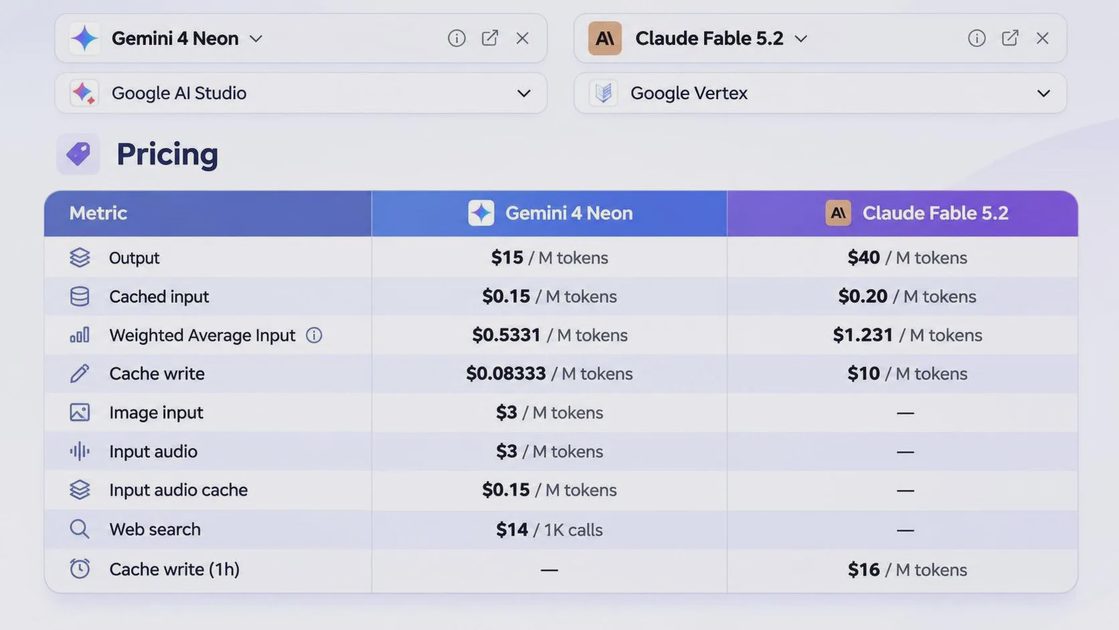
Pricing comparison between Gemini 4 Neon and Claude Fable 5.2, including output, cached input and cache write rates.
Coding sessions are chatty. You often make 10–20 small requests while refining a feature.
Neon at $3 / $15 per million tokens stays comfortable.
Fable 5.2 at $8 / $40 per million tokens becomes expensive if you treat it like a pair-programming partner for every tiny change.
That is why I treat Neon as the default and only escalate to Fable when the problem actually needs it.
Final takeaway
For everyday coding — cleaning functions, adding error handling, writing tests, and iterating — Gemini 4 Neon is currently the more practical choice. It is fast, focused, and much cheaper.
When the bug is confusing or the design needs careful thought, Claude Fable 5.2 is still worth the extra cost and time.
Most developers will get the best results by using Neon for volume and Fable 5.2 for the hard cases.
I tried it first. You can just copy.