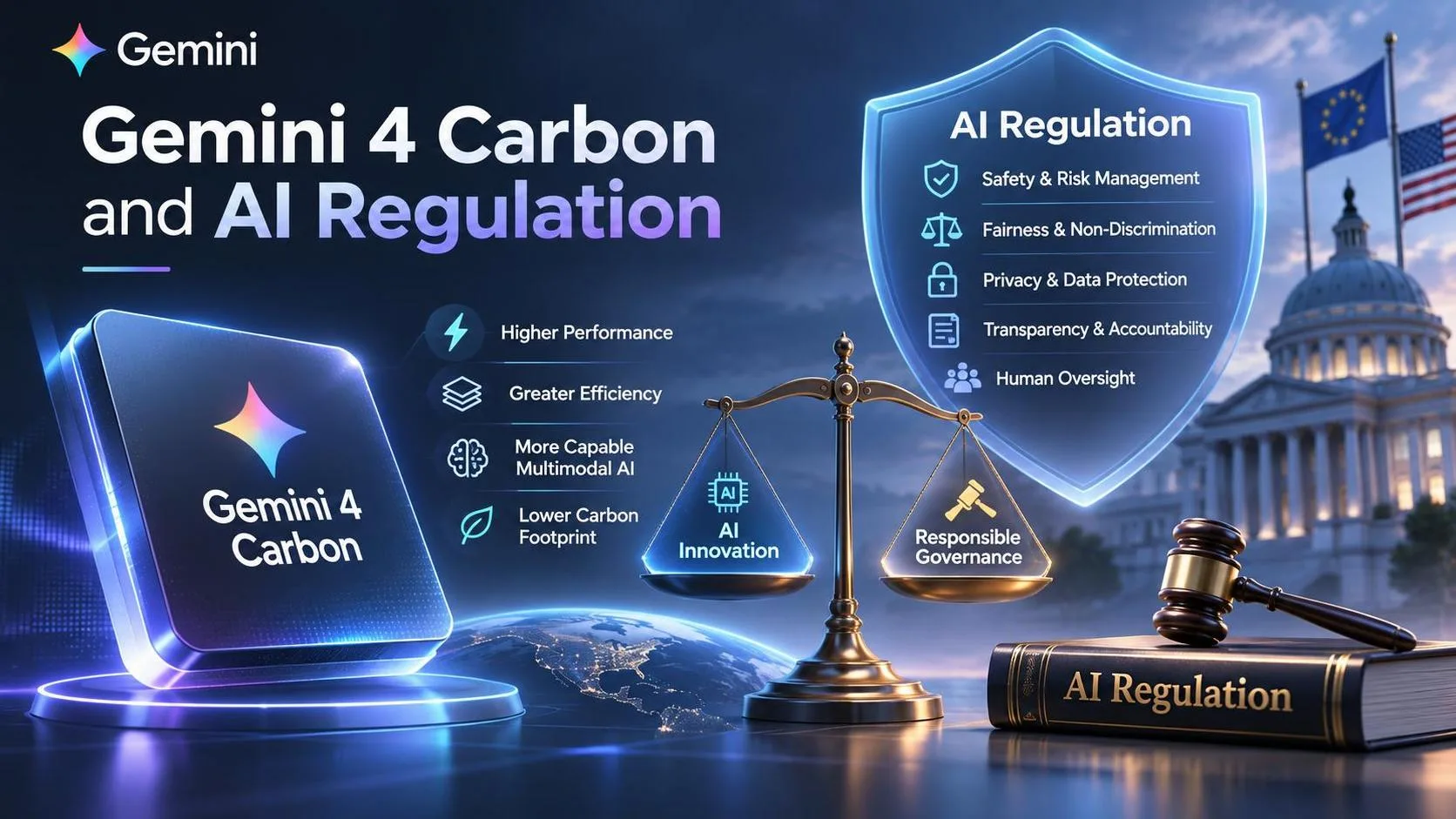
The political debate over artificial intelligence in the United States is entering a new phase. Democrats are preparing a tougher regulatory agenda after their midterm election gains, while technology companies are still racing to release increasingly capable AI models. And Google's Gemini 4 Carbon offers a timely example of why those two developments are colliding.
On November 6, Reuters reported that Democrats plan to introduce a series of AI-related bills when they take control of Congress in January 2027. Their priorities include independent safety evaluations for advanced AI systems, clearer legal responsibility when AI products cause harm, and protections against rising electricity costs associated with data centers.
At almost the same time, Google is taking a cautious approach to Gemini 4 Carbon. Despite presenting it as its strongest model for cybersecurity and long-running engineering tasks, Google has restricted its initial rollout to selected cyber defenders and trusted partners.
These are not directly connected events. There is no evidence that Democratic political pressure caused Google to restrict Carbon. But they point toward the same difficult question: As AI becomes more powerful, who should decide how quickly it reaches the public—and what safeguards should come first?
Why Are Democrats Pushing Back Against AI?
It would be inaccurate to describe the Democratic position as a blanket rejection of artificial intelligence. The party includes lawmakers who support AI development, others who want stronger oversight, and progressives who have called for much more aggressive restrictions.
What is changing is the political willingness to challenge the industry's current direction.
Following the 2026 midterm elections, Democrats are preparing to use their congressional influence to push several areas of AI policy.
Three issues stand out:
Policy concern | What Democrats want to address |
|---|---|
AI safety | Independent evaluations of advanced models and stronger oversight |
Corporate accountability | Clearer rules for when AI companies are responsible for harmful outcomes |
Data center expansion | Protecting consumers from electricity costs linked to energy-intensive infrastructure |
Senator Chuck Schumer has identified electricity costs associated with data center growth as a priority. Representative Lori Trahan plans to pursue legislation requiring independent experts to evaluate leading AI models against safety standards, as well as clarify corporate liability.
Other Democrats have called for stronger oversight structures and more scrutiny of major technology companies.
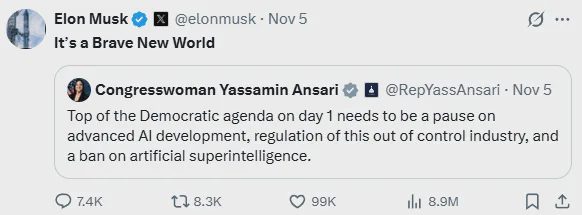
The infrastructure debate is especially visible outside Washington. Opposition to new data centers has become a local political issue because communities are concerned about electricity prices, water consumption, land use, and whether residents receive enough benefit from large infrastructure projects.
The Associated Press reported that many successful gubernatorial candidates in the 2026 elections supported stronger data center regulation or restrictions.
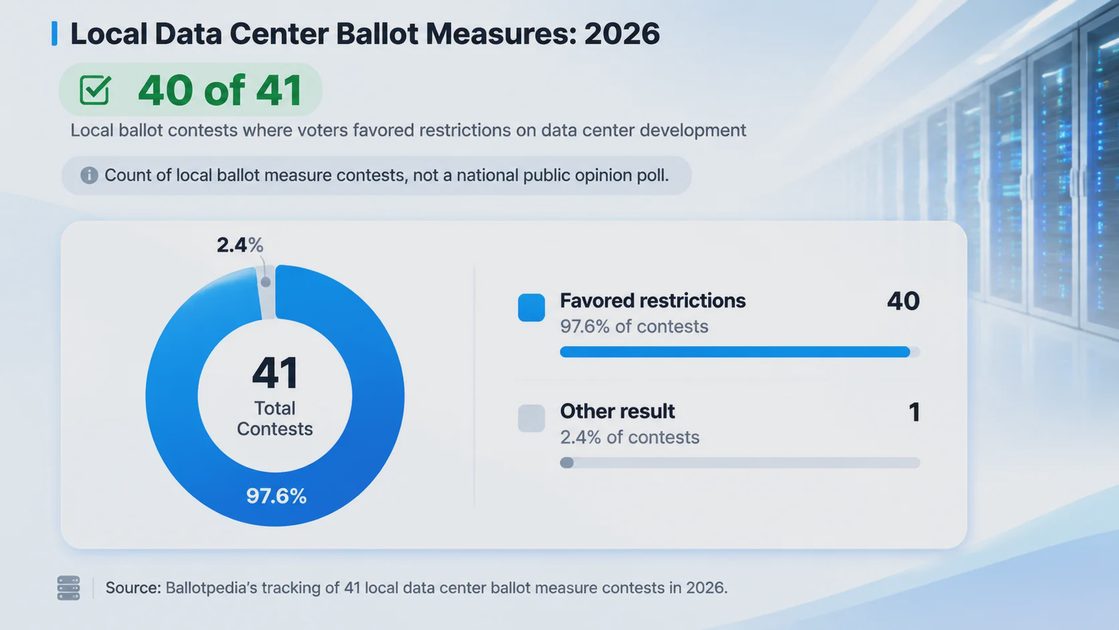
Local opposition is not limited to Democrats, either. Concerns about electricity and water have attracted voters across political lines.
That distinction matters. The current pushback is not simply about stopping AI research. It is also about who pays for the infrastructure, who benefits from it, and who bears the consequences when the technology creates problems.
Gemini 4 Carbon Shows Why AI Safety Is Becoming Harder to Ignore
Google announced Gemini 4 Carbon on October 28, describing it as its strongest model for long-horizon engineering and cybersecurity.
Its published cybersecurity results attracted particular attention:
Benchmark | Capability evaluated | Reported result |
|---|---|---|
SEC-bench Pro | Vulnerability discovery | 88.2% |
ExploitGym | Exploitation validation | 54.8% |
CWE-bench | Vulnerability remediation | 71.0% |
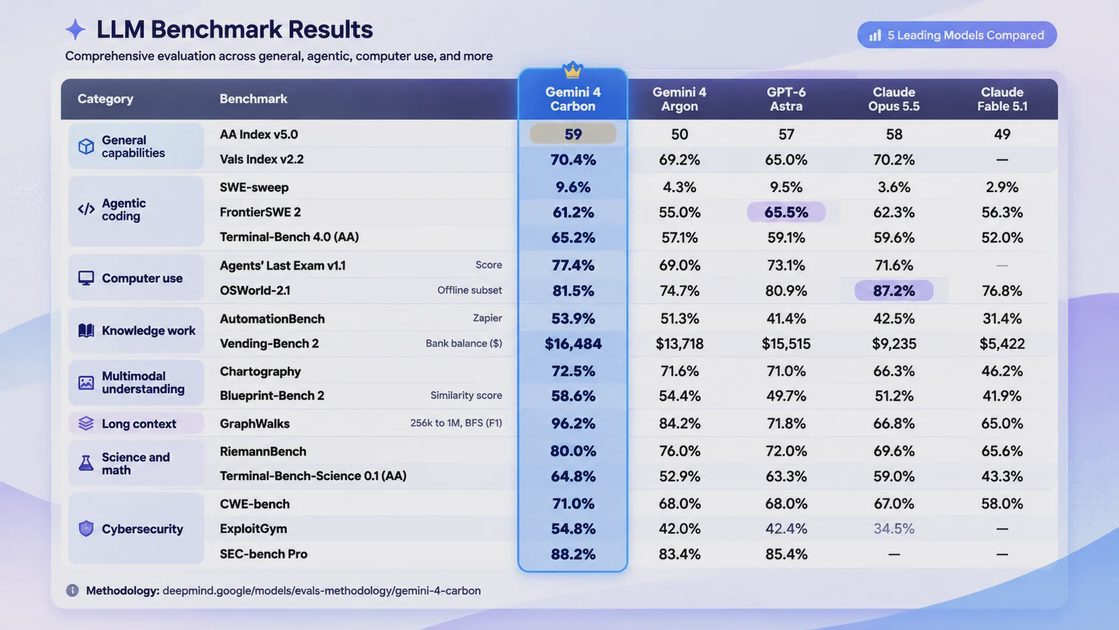
These benchmarks cover different stages of the cybersecurity process. Carbon is being evaluated not only on its ability to identify weaknesses, but also on whether it can validate risks and help fix underlying vulnerabilities.
That combination has obvious defensive value. Security teams could use a capable model to investigate software, prioritize vulnerabilities, and develop patches more efficiently.
But the same technical capabilities can create risks when used without authorization. A system that helps defenders understand how a vulnerability works may also provide useful assistance to someone attempting to exploit it.
This is the dual-use problem, and it is one reason Carbon is more relevant to the AI safety debate than another ordinary coding model.
Google says the cybersecurity benchmark evaluations were conducted without guardrails. The results therefore demonstrate performance under those evaluation conditions, not necessarily what an ordinary user will be able to do through a future public product.
The numbers are impressive, but they should not be interpreted as proof that Carbon can independently compromise real-world systems. Nor do they establish that every developer who gains access would use the model responsibly.
What they do show is that frontier models are moving deeper into areas where the difference between helpful automation and potentially harmful assistance depends heavily on context, authorization, and safeguards.
Why Is Google Restricting Gemini 4 Carbon?
Google has chosen a staged rollout rather than immediately releasing Carbon to everyone.
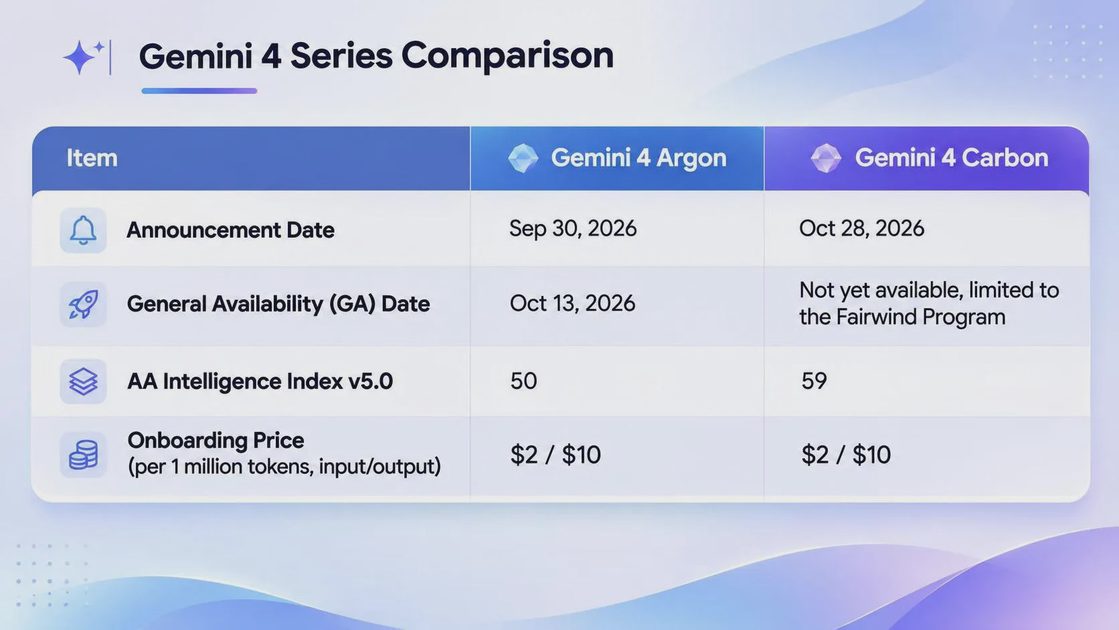
The company's announced approach has three parts:
Initial access for a subset of cybersecurity defenders.
Gradually expanding access to additional trusted partners through the Fairwind Program.
Broader availability for developers, businesses, and consumers after further feedback and safety work.
Google also says it is participating in the U.S. government's voluntary process for pre-release model testing.
This is significant because it shows that even a company competing to build more capable AI models recognizes the need to manage deployment risks.
However, Google's approach should not be confused with a government ban or a formal public finding that Carbon is unsafe. Google has described the rollout as a deliberate process for gathering feedback and refining safeguards.
There is also no confirmed public release date. Developers should not assume that an existing paid Gemini subscription automatically includes access to Carbon.
I see two sides to this decision.
On one hand, allowing experienced cybersecurity defenders to evaluate a powerful model before a wider release is a reasonable precaution. It gives Google an opportunity to learn how the model behaves in specialized environments.
On the other hand, restricted access makes independent evaluation harder. Most developers cannot test Carbon themselves, challenge its benchmark claims through their own workflows, or determine whether its capabilities justify the attention.
That creates a transparency problem. If companies increasingly decide which users can evaluate their strongest models, the public may have to rely heavily on company-selected partners and company-published results.
Should Governments Require Independent AI Safety Testing?
This is where the Democratic policy agenda and Google's Carbon rollout become particularly interesting.
Google has chosen to conduct pre-release testing and refine its own safeguards. Democrats, meanwhile, want independent experts to evaluate leading AI systems against safety standards.
Those approaches share a basic goal, but they are not interchangeable.
Company-led testing can be faster and more closely connected to a model's development process. Internal teams understand the system, can investigate failures, and can update safeguards directly.
Independent evaluations can provide a different perspective. External experts may identify weaknesses that internal testing misses, and common standards could make it easier to compare safety claims across companies.
Neither approach is automatically sufficient.
Independent testing needs transparent methods, credible technical expertise, and clear rules about what happens when a model fails an evaluation. Otherwise, it risks becoming another compliance exercise.
There is also a practical question about how much information companies should disclose. Publishing every detail of a vulnerability evaluation could create its own security risks, while publishing too little makes meaningful public oversight difficult.
A sensible framework would combine internal testing, qualified independent evaluation, and clear reporting requirements without assuming that one test can guarantee a model is safe.
Carbon is a useful example because its capabilities make those questions concrete rather than theoretical.
Could More AI Regulation Slow Down Innovation?
The concern from the technology industry is understandable. More testing requirements, legal exposure, and restrictions on infrastructure development could increase costs and delay new products.
Large companies may be able to absorb those expenses. Smaller AI startups and independent developers may find compliance more difficult, particularly if requirements are expensive or unclear.
Data center restrictions create another challenge. AI services depend on substantial computing infrastructure, and delays in new projects could affect capacity, investment, and the cost of running models.
But the opposite argument deserves attention, too.
Uncontrolled expansion can create public opposition, higher local costs, and a loss of trust. If communities believe AI infrastructure benefits technology companies while leaving residents with higher electricity bills or environmental burdens, political resistance is unlikely to disappear.
The same principle applies to model safety. If companies release increasingly capable systems without credible safeguards, a serious incident could lead to much harsher restrictions than a carefully designed regulatory framework would have required.
The real choice is not simply regulation versus innovation. It is whether the industry can develop rules that reduce preventable harm without making it unnecessarily difficult to build useful technology.
What Should Developers Expect From Gemini 4 Carbon?
For developers, the immediate situation has not changed: Gemini 4 Carbon remains in a restricted rollout, and Google has not announced a specific date for general availability.
That does not mean developers should ignore it.
Carbon's cybersecurity benchmarks and long-horizon engineering focus make it worth watching, particularly for teams working on code security, vulnerability analysis, and complex repository-level tasks.
But there are three things I would watch before considering it for a production workflow:
Access: Whether Google begins expanding availability beyond selected defenders and trusted partners.
Independent evaluation: Whether external researchers can validate its cybersecurity and coding capabilities under clearly documented conditions.
Practical safeguards: Whether the public product provides useful security controls without making legitimate development work unnecessarily difficult.
I would also keep the infrastructure debate separate from the model-access question. Restrictions on data center construction could affect the broader economics of AI, but they do not automatically determine when Carbon will become available.
For now, existing Gemini models and other coding tools remain the practical options for developers who need to build today.
AI Needs More Than Faster Models
The Democratic push for stronger AI oversight and Google's restricted Gemini 4 Carbon rollout are not two sides of a single political decision. They are separate developments that reveal how quickly the industry's priorities are changing.
For years, the central competition was about building more capable models, improving benchmark scores, and bringing new features to users faster.
That competition is not going away. But it is no longer the only question that matters.
Developers want access to powerful tools. Communities want infrastructure that does not leave them paying the bill. Policymakers want accountability when AI systems cause harm. Companies want enough freedom to keep innovating.
Those interests will not always align.
I don't think the answer is to stop building advanced AI models, nor do I think companies should be allowed to decide every safety question behind closed doors. The industry needs credible independent evaluation, clearer accountability, and a realistic path for legitimate users to access new capabilities.
Gemini 4 Carbon makes the debate tangible. Its capabilities are moving forward, but access is being held back while Google works through safety concerns.
The next stage of AI development will depend not only on how powerful models become, but also on whether the companies building them can earn the public's trust.
I tried it first. You can just copy.