Your next AI feature may work perfectly in a demo and still create problems when it reaches production.
Maybe the model produces an unsafe response. Maybe an autonomous agent takes an action nobody expected. Maybe a customer asks why your application made a particular decision, and your team cannot explain which model version, prompt, or data source was involved.
These are already practical engineering problems. But after the 2026 U.S. midterm elections, they are also becoming more important policy questions.
Democrats are preparing to make AI oversight a priority when the 120th Congress convenes in January 2027. Their proposals include independent model evaluations, safety incident reporting, clearer liability rules, and greater scrutiny of major AI companies. At the same time, the election has intensified questions about data center expansion, electricity demand, and the cost of building AI infrastructure.
For developers working with Gemini, OpenAI, Claude, or open-source models, this does not mean existing applications suddenly need to be rebuilt. Most of the proposals are not laws yet, and a presidential veto could limit what Congress can accomplish.
But there is a useful engineering takeaway: AI governance is moving closer to the development lifecycle. Teams that already understand how their models behave, track failures, and document important decisions will have a much easier time adapting if new requirements arrive.
Here is what the emerging policy landscape could mean for people building AI products.
What Changed After the 2026 Midterm Elections?
The November 2026 elections changed the political environment surrounding the AI industry. Democrats are set to control both chambers of Congress in the next session, and several lawmakers have publicly called for stronger oversight of advanced AI systems and technology companies.
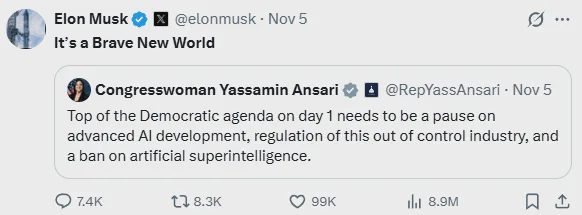
Some proposals go further than conventional consumer protection. Representative Yassamin Ansari has called for a pause on advanced AI development and a ban on artificial superintelligence.
Other lawmakers have focused on independent technical evaluations, mandatory reporting of serious safety incidents, developer accountability, and stronger federal oversight.
The proposals are not identical, and there is no single agreed-upon Democratic AI policy package. Some lawmakers emphasize catastrophic risks and frontier-model safety. Others focus on privacy, cybersecurity, labor, copyright, and the effects of AI infrastructure on local communities.
That distinction matters to developers. A proposal to evaluate advanced models before release would affect foundation-model providers differently from a rule requiring application developers to document how their products use those models.
The immediate change is not a new technical requirement. It is a stronger likelihood of hearings, investigations, policy proposals, and public questions about how AI systems are developed and deployed.
Independent AI Testing Could Become More Important
One of the clearest themes in the emerging regulatory discussion is independent evaluation.
Today, AI companies typically conduct internal testing before releasing models or major capabilities. They may evaluate accuracy, safety, harmful outputs, cybersecurity risks, and performance on specialized benchmarks. External researchers and independent organizations also conduct evaluations, but the process and level of access vary.
Some lawmakers want stronger requirements for independent reviews of advanced models before release. Senator Maria Cantwell has outlined a framework calling for enforceable safety standards, independent audits, and access for qualified outside evaluators. Other proposals would require companies to report significant incidents involving AI systems.
For developers, the practical lesson is that a model passing a few internal tests should not be treated as proof that an application is safe in production.
Consider a Gemini-powered support assistant. A basic test might confirm that it answers common questions correctly. A more useful evaluation would also check whether it:
Reveals information from another customer's conversation.
Follows malicious instructions embedded in uploaded documents.
Invents account policies when it cannot find an answer.
Calls tools with incorrect arguments.
Continues an operation after a required approval is missing.
These tests do not require waiting for federal legislation. They are part of responsible application engineering.
If independent evaluations become more common, teams with repeatable test cases, documented model versions, and clear evaluation results will be better prepared to demonstrate how their systems behave.
AI Safety Incidents Could Become a Reporting and Liability Issue
Another important policy direction concerns what happens when AI systems fail.
A model generating an incorrect answer is not the same as an autonomous agent performing an unauthorized action. As applications gain access to databases, external APIs, cloud resources, and business tools, the consequences of a failure can become more serious.
Lawmakers have discussed mandatory reporting of critical safety incidents, clearer liability rules, and stronger accountability for AI developers. House Democratic committee leaders have also requested information from major frontier AI companies about model misalignment and safety incidents, including rapid notification of newly discovered problems.
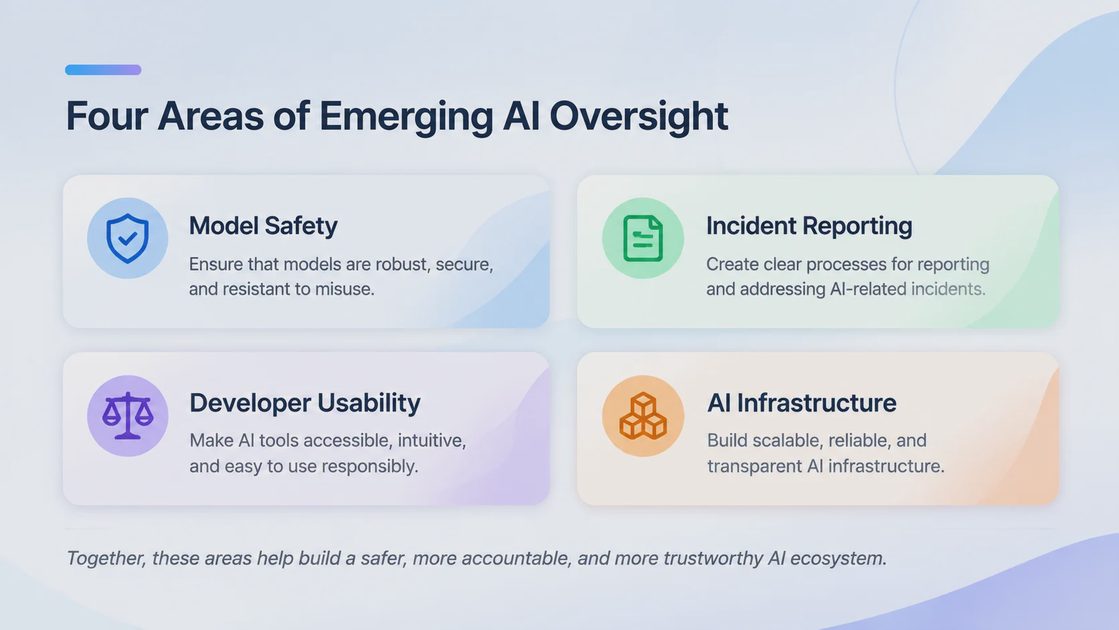
These developments point toward a more demanding approach to incident management. They do not establish a universal reporting obligation for every developer, but they show why teams should understand what their AI systems are doing.
A practical starting point is to maintain an incident record that captures:
Model details: Provider, model identifier, version, and relevant configuration.
Input context: The request, retrieved information, and tool outputs involved, with sensitive data handled appropriately.
System behavior: What the model generated and which actions the application attempted.
Impact: Whether customer data, business operations, or external systems were affected.
Response: How the issue was contained, investigated, and corrected.
For applications using function calling or AI agents, I would pay particular attention to action logs and permission boundaries. A system should not be able to perform a high-impact operation simply because the model generated a plausible-looking tool call.
Human approval, scoped credentials, rate limits, and reversible actions are still useful safeguards. They also make it easier to investigate a failure when something goes wrong.
What AI Liability Could Mean for Application Developers
The liability debate deserves attention because it raises a question that every AI product team should already be asking: who is responsible when an AI-powered application causes harm?
The answer may depend on the situation. A foundation-model provider controls the underlying model. An application developer chooses how that model is prompted, what information it receives, which tools it can access, and how its output is presented to users. An organization deploying the application may control the business process in which the output is used.
Those responsibilities are not interchangeable.
For example, imagine a startup using Gemini to summarize customer records and recommend follow-up actions. The model provider supplies the underlying capability, but the startup decides whether the application can access sensitive records, whether a human reviews recommendations, and whether an automated action can be triggered.
A model error may be part of the incident, but the surrounding application design matters too.
That is why developers should avoid treating an API provider's safety documentation as a substitute for application-level safeguards. Before shipping a feature, identify which decisions are made by the model, which are made by application code, and which require human approval.
Clear responsibility boundaries are useful even before lawmakers agree on a specific liability framework.
Data Center Rules Could Affect AI Infrastructure and Cloud Costs
AI regulation is not limited to model behavior. The 2026 election also brought data center development and electricity demand into sharper focus.
Local communities have raised concerns about power consumption, water use, land development, and whether ordinary utility customers could end up paying for infrastructure upgrades. In the midterm ballot measures tracked by Ballotpedia, voters favored restrictions on data center development in 40 of 41 local contests.
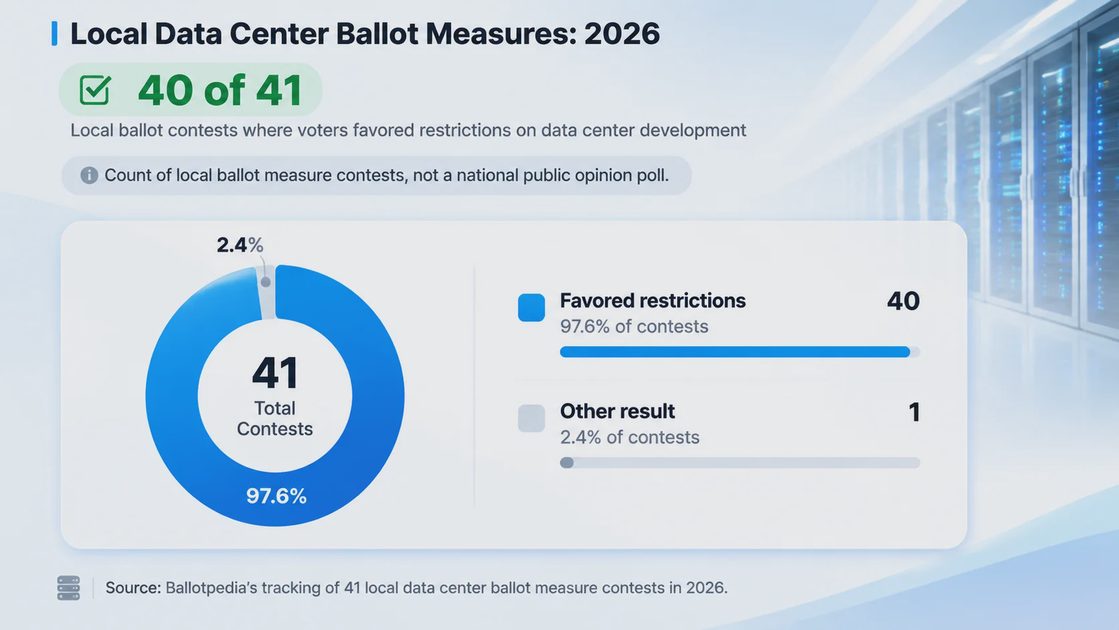
The Fox Business report also highlighted an important distinction between federal and state-level policy. Even with Democrats controlling Congress, President Trump's veto authority could make sweeping federal restrictions difficult. State-level pauses and local approval requirements may have a more direct effect on where and when new facilities are built.
UBS strategists cited by Fox Business estimated that roughly 30% of expected 2028 data center additions could be affected by potential pauses, with Texas representing a significant share of the capacity at risk. That is an analyst estimate, not a confirmed forecast of projects that will be canceled.
For software teams, the practical implication is uncertainty around infrastructure availability and cost. More scrutiny of power demand or delays in new facilities could affect the economics and timing of future capacity expansion.
This does not mean Gemini API or other hosted AI services are about to become unavailable. Developers should avoid making that leap. But teams planning large-scale AI workloads should pay attention to cloud pricing, regional capacity, provider commitments, and the cost of running increasingly demanding models.
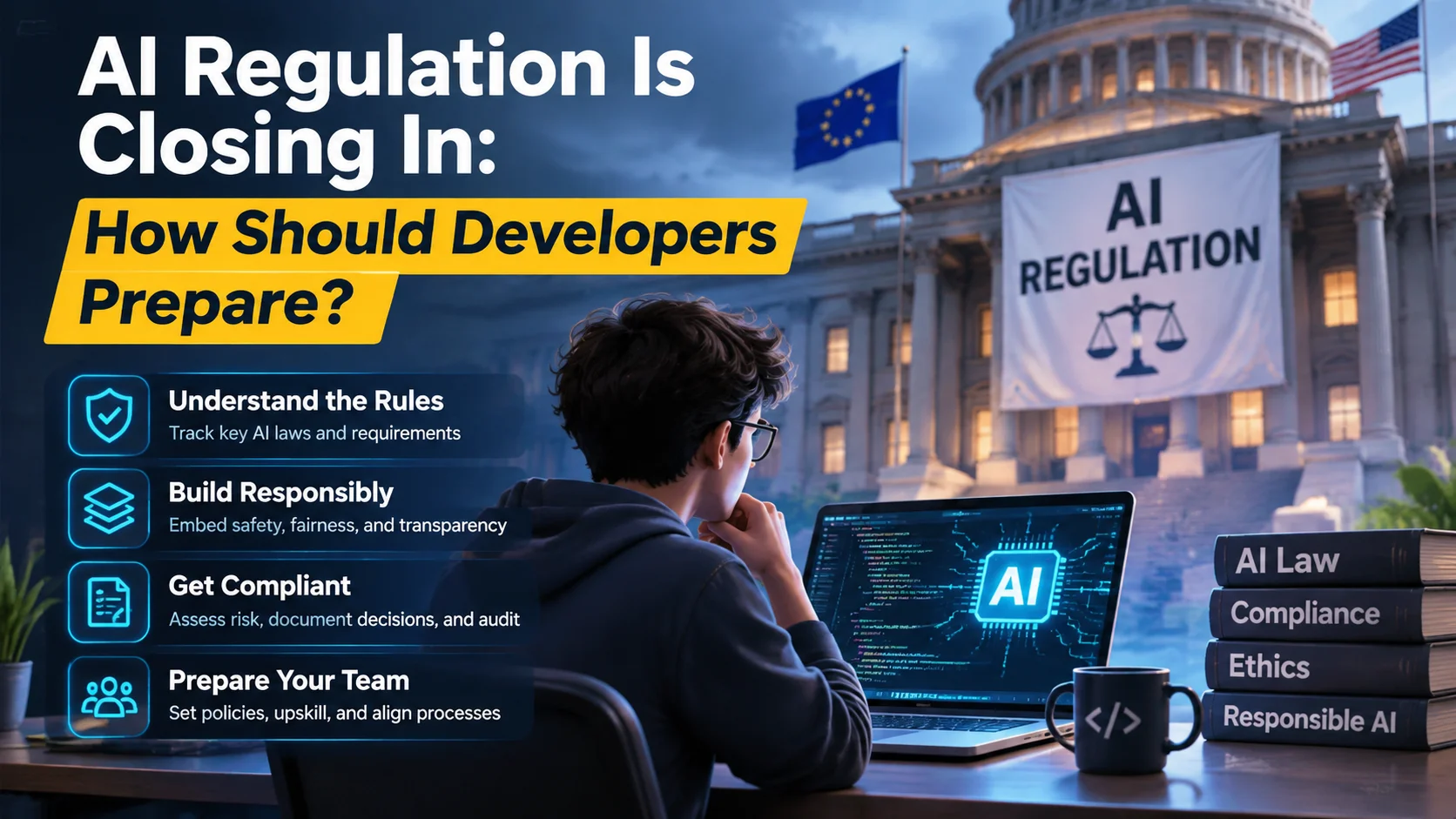
What Developers Building with Gemini Should Do Now
I would not pause a product roadmap because of proposals that have not become law. I would use this moment to make the application easier to test, explain, and maintain.
For a Gemini-powered application, that means looking beyond the API call itself.
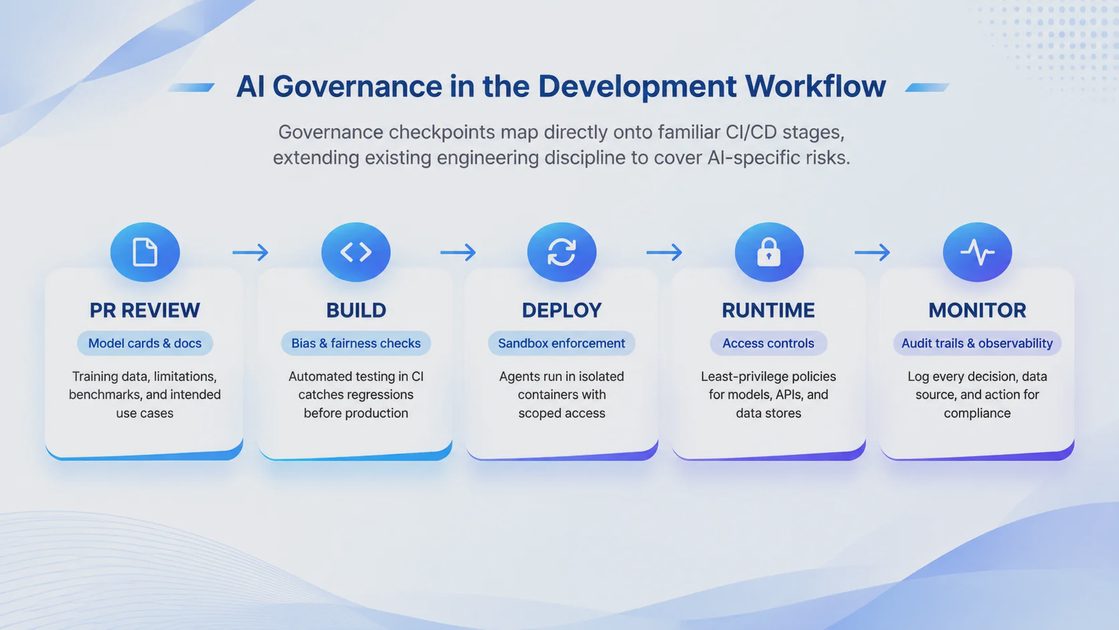
First, build model evaluations into development. Keep a small but meaningful test set covering normal requests, edge cases, unsafe inputs, and tool-use failures. Run it again when changing models, prompts, retrieval settings, or application logic.
Second, separate model output from application decisions. Let the model propose an action, but use deterministic code to validate permissions, required fields, and business rules. High-impact operations should have explicit approval steps.
Third, make important behavior traceable. Record model identifiers, prompt versions, tool calls, relevant configuration, and outcomes. Avoid storing unnecessary personal information, and apply appropriate access controls and retention limits.
Fourth, review provider dependencies. Understand what your application would need to change if a model, API version, pricing structure, or regional service availability changed. Keep business logic separate from provider-specific code where practical.
Finally, document what your system cannot reliably do. If an AI assistant is not designed to make financial decisions, access certain records, or execute sensitive operations, make those boundaries clear in the application—not just in internal documentation.
These are engineering practices, not a claim that a new federal checklist already exists. They are useful because they reduce operational risk and make future policy changes less disruptive.
The Rules Are Still Being Written. The Engineering Work Can Start Now.
The 2026 midterm elections have made AI oversight a more prominent issue in Washington, but the outcome is far from settled. Proposed legislation could face presidential opposition, lawmakers disagree on how far restrictions should go, and state-level rules may develop at different speeds.
For developers, the important shift is that AI safety, accountability, and infrastructure are becoming harder to treat as separate concerns from product development.
A reliable AI application needs more than a capable model. It needs evaluations that catch failures, permissions that limit what the system can do, records that help explain what happened, and a deployment strategy that accounts for provider and infrastructure changes.
You do not need to predict every regulation to build with those principles in mind.
The demo is easy. The edge cases are the real tutorial.
I tried it first. You can just copy.