Rumors suggest that shortly after releasing its first three models and world models, Google is preparing to drop its heavyweight flagship: Gemini 4 Krypton. The community-mapped Gemini 4 elemental matrix divides roles cleanly:
Hydrogen: Lightweight workhorse, ultra-fast and low-cost, tailored for everyday chat and high-frequency developer tasks.
Argon: Balanced reasoning and multimodal model, striking the ideal chord between performance and utility.
Carbon: Advanced deep-reasoning model built for complex algorithms, code refactoring, and cybersecurity.
Krypton: Rumored heavyweight flagship, directly targeting Fable 5.2 and GPT-6.2 Sol to tackle ultra-high-difficulty tasks.
A few months ago, when Gemini 3.5 Pro kept stumbling with frustrating delays, skeptics wrote Google off. But by completely rearchitecting its foundational base models, integrating full-stack silicon, custom models, and end-to-end applications, Google has bounced back in a major way. The full-stack model race is heating up, and we are about to see who comes out on top.
“I tried it first. You can just copy.”
As an engineer who prefers checking API catalogs, verifying official changelogs, and running hands-on tests in a clean environment, my first reaction to this buzz is always pragmatic: What exact class of model is Krypton? Is it in the official API catalog yet? Can we write code against it today, or should we focus strictly on architecture readiness?
Let’s strip away the hype and evaluate Gemini 4 Krypton across its technical positioning, official status, and actionable API preparation strategies.
Table of Contents
What is Gemini 4 Krypton? Where Does It Sit in the Matrix?
Status Check: Is It Officially Released and Accessible via API?
The Rumor Chain: From Periodic Table Codewords to Arena Sightings
Developer Preparation Guide: How to Future-Proof Your API Architecture
Summary: What Worked / What Failed / Production Takeaways
1. What is Gemini 4 Krypton? Where Does It Sit in the Matrix?
To understand Gemini 4 Krypton, you have to view it through the lens of Google's completely overhauled "periodic table" model architecture.
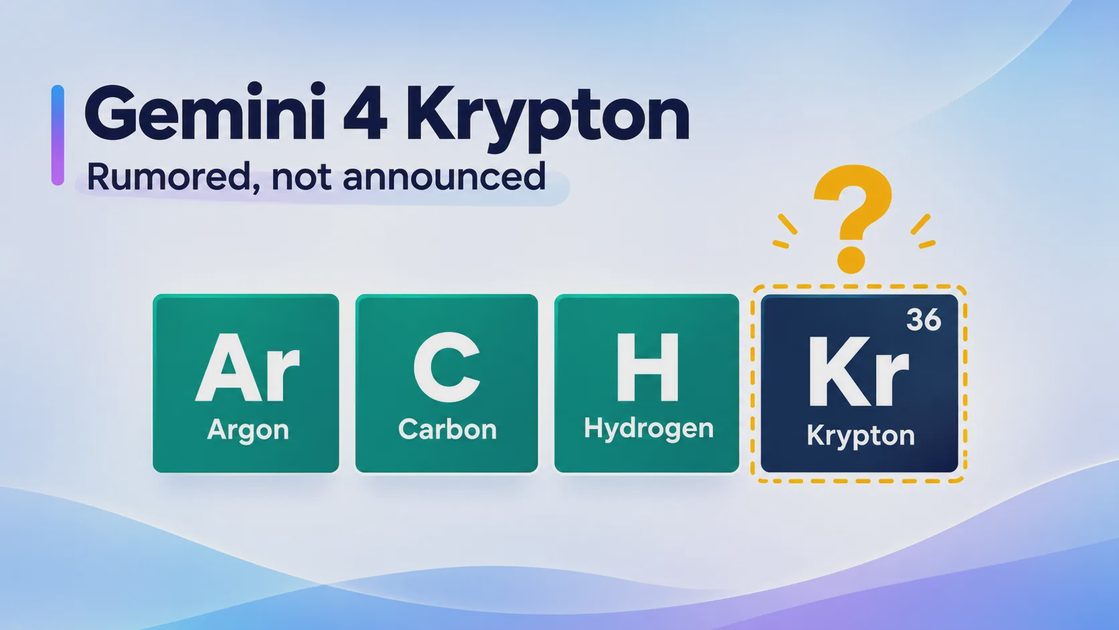
Having moved away from rigid single-dimension sizing, Google uses chemical element characteristics to define compute tiers and workload boundaries:
Why Krypton? On the periodic table, krypton represents a heavier, denser noble gas compared to argon. In the model lineup, the community and technical circles position Krypton as the Gemini 4 heavyweight flagship / high-compute reasoning ceiling.
Target Positioning & Benchmarks: If Hydrogen handles 80% of everyday low-latency loops, Argon acts as the core knowledge and long-context engine, and Carbon drives complex code refactoring and algorithms, then Krypton is engineered to conquer ultra-complex reasoning, advanced multi-step planning, and heavy logical deduction—directly going head-to-head with top-tier competitors like Fable 5.2 and GPT-6.2 Sol.
Full-Stack Synergy: Backed by Google’s proprietary TPU silicon, native multimodal design, and tightly integrated developer tools (Google AI Studio and Vertex AI), Krypton is designed to unlock the absolute ceiling of Google's modernized AI stack.
2. Status Check: Is It Officially Released and Accessible via API?
With its technical positioning clear, we must look at the hard reality: As of mid-November 2026, Google has not officially announced, named, or publicly released any model called "Gemini 4 Krypton".
Checking the official Gemini API Model Catalog, Changelog, or major third-party API aggregators (such as APIMaster and OpenRouter) reveals no model ID containing krypton or gemini-4-krypton.
The officially verified and accessible Gemini 4 lineup currently stands as follows:
Gemini 4 Argon: Launched on October 13, 2026, serving as the flagship long-context and knowledge-work engine.
Gemini 4 Carbon: Opened to paying developers and Ultra subscribers on November 10, 2026, tailored for deep reasoning and production pipelines.
Gemini 4 Hydrogen: Rolled out in mid-November 2026 as the lightweight Flash-tier workhorse, boasting a 2.5X speedup over 3.8 Flash and 4 configurable thinking levels.
Model Name | Elemental Role | Official Status | Release Date | Target Workload |
Gemini 4 Hydrogen | Lightweight Workhorse | Active / Available | Mid-November 2026 | Everyday chat, rapid coding support, low-latency agent routing. |
Gemini 4 Argon | Balanced Flagship | Generally Available | October 13, 2026 | Long-context analysis, multimodal comprehension, routine knowledge work. |
Gemini 4 Carbon | Advanced Deep Reasoning | Open to Developers | November 10, 2026 | Complex algorithms, multi-file code refactoring, cybersecurity audits. |
Gemini 4 Krypton | Heavyweight Flagship | Rumored / Unannounced | No Official Date | Ultra-high-difficulty reasoning vs. Fable 5.2 / GPT-6.2 Sol (Pending verification). |
3. The Rumor Chain: From Periodic Table Codewords to Arena Sightings
How did the Krypton narrative explode across the community without an official press release? Tracking the timeline reveals a familiar pattern:
Internal Codename Leaks: Around November 13, an online leak exposed a list of chemical element names used internally by Google for upcoming model series—with "Krypton" sitting at the top.
LMSYS Chatbot Arena Speculation: By November 14, screenshots and theories spread claiming Krypton was quietly being evaluated in blind tests under internal checkpoints (like
krypton-a), with some rumors placing it under agemini-4-hydrogentest tag.Community Retractions: Independent developers later confirmed these sightings were largely unverified tag strings or custom renamings by testers, with initial posters subsequently walking back their claims.
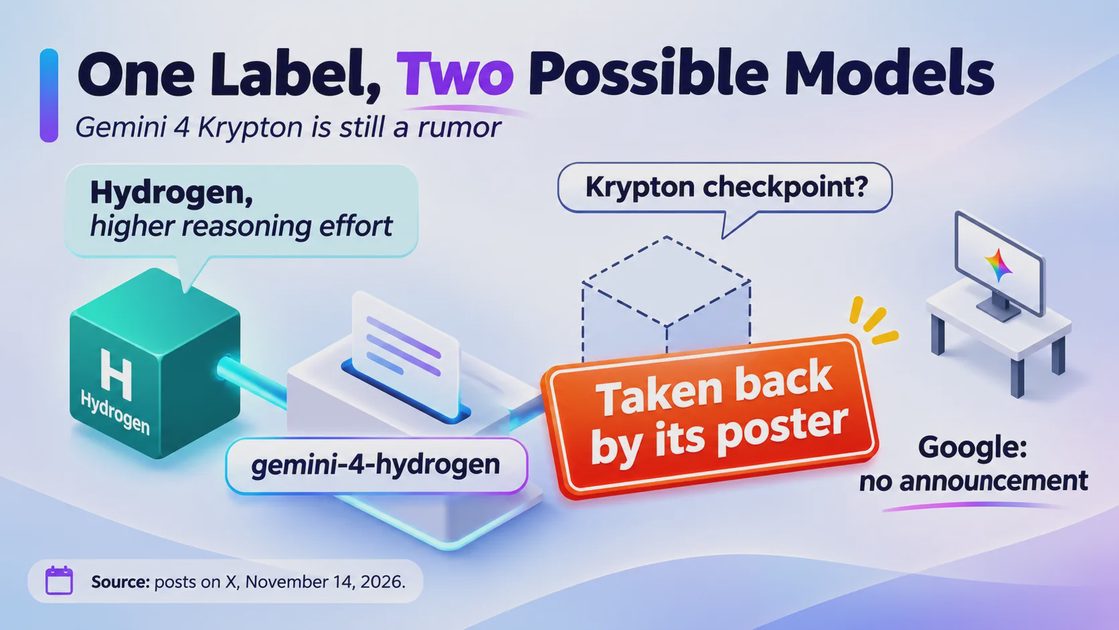
Engineering Takeaway: During an intense AI arms race, tech giants routinely use periodic table elements (Argon, Carbon, Hydrogen, Krypton) as internal build codenames. However, an internal test checkpoint does not equal commercial release readiness, and internet release date predictions carry zero official weight.
4. Developer Preparation Guide: How to Future-Proof Your API Architecture
Whenever a "heavyweight flagship" rumor surfaces, technical teams often fall into the trap of pausing development to wait.
Drawing from APIMaster’s integration workflows and Gemini Build Lab testing standards, the most pragmatic path is not guessing release dates, but building a flexible architecture that lets you drop in new models instantly:
Step 1: Decouple Model IDs at the Gateway Layer
Whether calling the Google GenAI SDK directly or routing through an API gateway like APIMaster, never hardcode model strings deep inside your business logic. Isolate your model configurations into environment variables or configuration centers:
Python
import os
from google import genai

client = genai.Client()

# Decouple the model ID via environment variables (currently running on Carbon)
# Once Google officially launches gemini-4-krypton, you only update this config.
ACTIVE_HEAVY_MODEL = os.getenv("GEMINI_HEAVY_MODEL", "gemini-4-carbon")

def solve_complex_task(prompt: str):
    response = client.models.generate_content(
        model=ACTIVE_HEAVY_MODEL,
        contents=prompt,
    )
    return response.text
Step 2: Establish a Golden Evaluation Dataset
Curate 20 of your team's toughest real-world prompts (e.g., complex SQL tuning, cross-module bug isolation, or rigorous logical deduction) into an automated testing script. Run them against Gemini 4 Carbon today to establish baseline metrics (accuracy, time-to-first-token, and token costs). When Krypton officially lands in the API catalog, run the exact same test harness to determine empirically if the heavyweight flagship justifies its processing overhead.
5. Summary: Production Takeaways
Following the Gemini Build Lab review checklist, here is our bottom line for your production stack:
What worked:
Leveraging the already deployed Argon, Carbon, and high-speed Hydrogen models to build a tiered routing engine. Hydrogen handles high-frequency tasks, while Carbon tackles heavy engineering today.
What failed:
Stalling product roadmaps waiting for unverified Krypton release rumors, or hardcoding unreleased strings like
gemini-4-kryptoninto codebases (resulting in immediate404 Model Not Founderrors).
What I would change in production:
Keep configurations decoupled and maintain robust evaluation benchmarks. Google’s rearchitected stack is exceptionally powerful, but as engineers, we keep Krypton on our radar while shipping code with what is available today. The moment Krypton hits the official API, we’ll run it through the lab.
“Here’s the smallest version that works.” Until Google officially ships it, mastering Argon and Carbon to keep your current systems robust is the most reliable engineering choice.