What if Gemini 4 Hydrogen delivers something close to Gemini 4 Argon's intelligence at Flash-level prices—and runs several times faster? That is the possibility making the rumored model interesting. But before anyone redesigns an API stack around it, there is a problem: Google has not publicly confirmed Hydrogen as a product.
A checkpoint reportedly appeared in Arena testing under the name "gemini-3.8-flash," with the latest sighting attributed to November 5, 2026, at 6:05 PM Pacific Time. Other circulating claims describe five Hydrogen checkpoints and generation speeds of 300–500 tokens per second.
Those claims are exciting. They are not the same as a release announcement, verified benchmark, or public API.
My view is simple: Hydrogen could become Google's most interesting developer model if it combines Argon-like reasoning with Flash economics. Until Google publishes the actual model specifications, though, it belongs on a watchlist—not in a production migration plan.
ON THIS PAGE
What Is Gemini 4 Hydrogen?
Could Hydrogen Replace Gemini 4 Argon?
The Price Difference Developers Are Watching
Could Hydrogen Really Reach 500 Tokens per Second?
How Reliable Are the Arena Leaks?
When Will Gemini 4 Hydrogen Be Available?
What I Would Test Before Switching
My Verdict
What Is Gemini 4 Hydrogen?
Gemini 4 Hydrogen is the unofficial name attached to a rumored Flash-tier model or group of development checkpoints.
According to reports circulating in developer communities, Google may be evaluating new checkpoints through Arena-style comparisons, sometimes under an existing Gemini 3.8 Flash label.
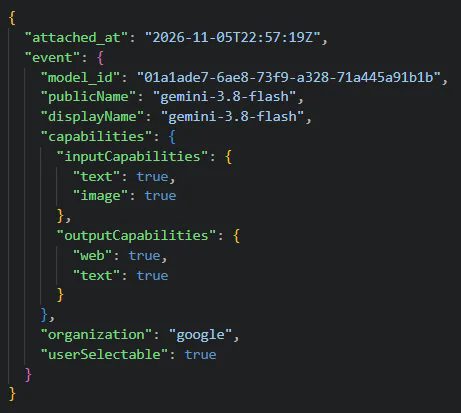
One reported observation places a checkpoint on November 5 at 6:05 PM PT.
Another claim mentions five Hydrogen checkpoints undergoing testing.
Neither claim establishes that Hydrogen is an official product name, that the checkpoints are all distinct release candidates, or that any of them will ship publicly.
A checkpoint is essentially a saved state of a model during development. Teams can evaluate different checkpoints, change training methods, or discard versions that don't meet their requirements.
Five checkpoints do not mean five upcoming products.
They also don't prove that a release is imminent.
What Is Actually Confirmed?
Claim | Status |
|---|---|
Gemini 3.8 Flash is an existing Google model | Confirmed |
Hydrogen is an official Gemini 4 Flash product | Unconfirmed |
Hydrogen is being tested under a 3.8 Flash label | Community report |
Five Hydrogen checkpoints exist | Unverified claim |
Hydrogen generates 300–500 tokens per second | Unverified claim |
Public API identifier and pricing | Not established |
General availability date | Not announced |
That distinction matters because an anonymous testing label isn't a reliable way to identify the underlying model.
Even if a response appears unusually capable, it could reflect a different checkpoint, a changed inference configuration, or a testing environment unavailable to ordinary API customers.
Could Hydrogen Replace Gemini 4 Argon?
This is the question behind most of the excitement.
Gemini 4 Argon represents a higher-capability model tier, while Flash models traditionally target faster and more economical workloads.
If Hydrogen delivers much of Argon's reasoning performance at Flash prices, it could change how developers divide tasks between expensive and inexpensive models.
But the supplied benchmark image does not establish that outcome.
The image compares Gemini 4 Hydrogen, Carbon, Argon, GPT-6 Astra, and Claude models across reasoning, coding, knowledge work, long-context, and cybersecurity evaluations.
It shows Hydrogen scoring 58 on AA Index v5.0, compared with Argon's 50 and Carbon's 59.
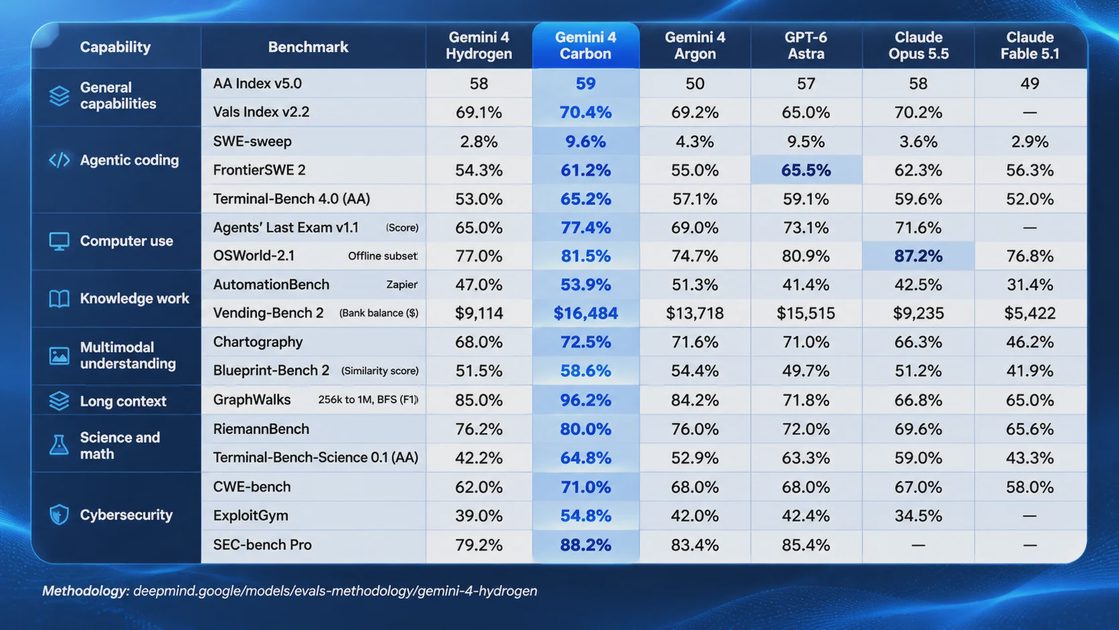
That's a striking result—but the image alone doesn't establish who evaluated Hydrogen, which checkpoint was used, whether the test was independently reproduced, or whether the numbers represent an eventual public model.
I would treat the Hydrogen column as an unverified benchmark claim.
Why One Intelligence Score Isn't Enough
Even a genuine overall score would only be the beginning.
The supplied comparison shows substantial variation across individual tasks.
For example, Hydrogen is listed at 54.3% on FrontierSWE 2, below Carbon's 61.2% and Argon's 55.0%.
On the same image, Hydrogen scores 85.0% on GraphWalks, while Carbon reaches 96.2%.
Those differences illustrate why I wouldn't assume that a strong aggregate score means consistent superiority.
For a developer building a document assistant, knowledge-work accuracy may matter most. For a coding agent, repository-level success and tool reliability could matter more.
The best model isn't the one with the highest overall score. It's the one that completes your actual workload reliably at an acceptable cost.
The Price Difference Developers Are Watching
The economic argument for Hydrogen is easier to understand than the benchmark speculation.
Google's published introductory pricing for Gemini 3.8 Flash includes $0.75 per million input tokens and $3.75 per million output tokens.
By comparison, the Argon pricing discussed in developer communities is $10 per million output tokens during its promotional period, with a possible increase to $20 afterward.
The Argon figures and promotional deadline should be verified against the current official rate card before making a purchasing decision.
Hydrogen has no confirmed public price.
Still, we can illustrate why developers are interested.
Model or Scenario | Output Price per 1M Tokens | Status |
|---|---|---|
Gemini 3.8 Flash | $3.75 | Published introductory rate |
Gemini 4 Argon | $10.00 | Reported promotional rate; verify |
Argon after promotion | $20.00 | Reported future rate; verify |
Hydrogen at Flash pricing | $3.75 | Hypothetical scenario |
Suppose an application generates 50 million output tokens in a month.
At $3.75 per million, the output bill would be $187.50.
At $10 per million, it would be $500.
At $20 per million, it would reach $1,000.
These calculations exclude input tokens, caching, tool charges, retries, and other usage-dependent costs.
They also don't prove that Hydrogen will receive Flash pricing.
But they explain the appeal: if a less expensive model can achieve similar task success rates, the savings become meaningful at scale.
The Metric I Would Actually Use
I would calculate cost per successful task rather than compare token prices in isolation.
A cheaper model that repeatedly produces invalid JSON or requires multiple retries may cost more than a higher-priced model that succeeds immediately.
For an automated workflow, I'd include failed calls, validation attempts, and human correction time in the calculation.
Could Hydrogen Really Reach 500 Tokens per Second?
The rumored speed range of 300–500 output tokens per second is arguably more interesting than the model name.
If sustained under real API conditions, that throughput could be valuable for chat interfaces, document summarization, and high-volume automation.
But we need to distinguish generation throughput from total response latency.
A model can generate output quickly after it starts while still taking substantial time to process a prompt, reason internally, or wait in a request queue.
For production applications, I would measure:
Time to first token: How quickly does a response begin?
Output throughput: How many tokens are generated per second?
End-to-end latency: How long does the complete task take?
Concurrency: How does performance change under parallel requests?
Tail latency: What happens to the slowest requests?
The circulating comparison with Argon's roughly 68 tokens per second makes Hydrogen sound dramatically faster.
But without identical workloads, output lengths, reasoning settings, and infrastructure conditions, that comparison isn't reproducible.
I'd be interested in a 300-token-per-second model. I wouldn't budget capacity around that figure until it appears in documented testing.
How Reliable Are the Arena Leaks?
The biggest problem with the Hydrogen story is the evidence chain.
Several reports trace back to model-tracking accounts and community observations rather than Google documentation.
That doesn't automatically make them false. Developers sometimes notice experimental models before official announcements.
But there is a difference between observing an unusual response and proving the identity of the system that generated it.
For me, credible evidence would include at least some of the following:
An official Google model identifier.
A published model card or technical announcement.
Documented API access conditions.
A reproducible benchmark with named model settings.
Independent testing across multiple workloads.
Confirmed pricing and rate limits.
The currently circulating Hydrogen claims don't provide that complete evidence.
The supplied benchmark table is useful as a discussion starting point, but it isn't enough to establish official performance.
I also wouldn't infer a release date from a checkpoint timestamp.
Model development can involve repeated evaluations long before a product is ready for customers.
When Will Gemini 4 Hydrogen Be Available?
There is no confirmed public release date for Gemini 4 Hydrogen in the sources reviewed for this article.
Google has not established Hydrogen as a publicly documented API model.
Some community discussions speculate about a mid-November launch, including predictions tied to November 13.
Those dates are speculation, not a Google announcement.
A prediction-market probability is also not evidence that an internal launch schedule exists.
For developers who want to know when they can actually use the model, I would watch for three milestones:
Google adds a clearly identified model to its official documentation.
The API exposes that model with published access requirements.
Pricing, quotas, and supported capabilities become available.
Until those conditions are met, there's no dependable integration target.
And I wouldn't assume that a model called Hydrogen will eventually launch under the name Gemini 4 Flash.
What I Would Test Before Switching
If a new Flash-tier Gemini 4 model becomes available, my first experiment would be a controlled comparison against Gemini 3.8 Flash and Argon.
I wouldn't begin with a spectacular demo prompt.
I'd use 30–50 tasks representing a realistic application workload, including structured extraction, summarization, code changes, and tool-using workflows.
Test | Success Measure | Failure to Watch |
|---|---|---|
Structured extraction | Schema-valid, accurate output | Invented fields |
Long document summary | Coverage and factual consistency | Missing constraints |
Coding task | Passing tests | Unrelated code changes |
Tool workflow | Successful completion | Incorrect tool arguments |
High-concurrency calls | Latency and error rate | Throttling and slow requests |
For each run, I'd record the exact model identifier, reasoning settings, token usage, latency, cost, and task outcome.
Then I'd compare the percentage of accepted outputs and the total cost of producing them.
I'd also repeat a subset of the tasks to identify unstable behavior.
A model that occasionally produces brilliant results but fails routine validation isn't automatically a better production choice.
And if Hydrogen really approaches Argon's performance at Flash pricing, those results should become visible in a properly controlled test.
My Verdict
Gemini 4 Hydrogen is interesting because it represents a product developers genuinely want: strong reasoning without frontier-model latency and pricing.
But that product is still hypothetical.
The Arena sightings are not enough to establish a final model identity. The benchmark comparison isn't independently verified. And the rumored throughput and pricing remain unconfirmed.
So my recommendation is to keep existing applications on documented, accessible models while preparing a small evaluation suite for a possible new Flash release.
Don't rewrite your architecture around a codename.
Don't assume a checkpoint label reveals the underlying model.
And don't confuse a promising benchmark screenshot with a production-ready API.
If Hydrogen eventually delivers Argon-like capability at Flash-level cost and speed, it could become one of Google's most useful developer releases. The evidence that would justify switching simply isn't here yet.
That's the distinction worth remembering while the rumors circulate.
Test the model. Build the workflow. Ship what works.