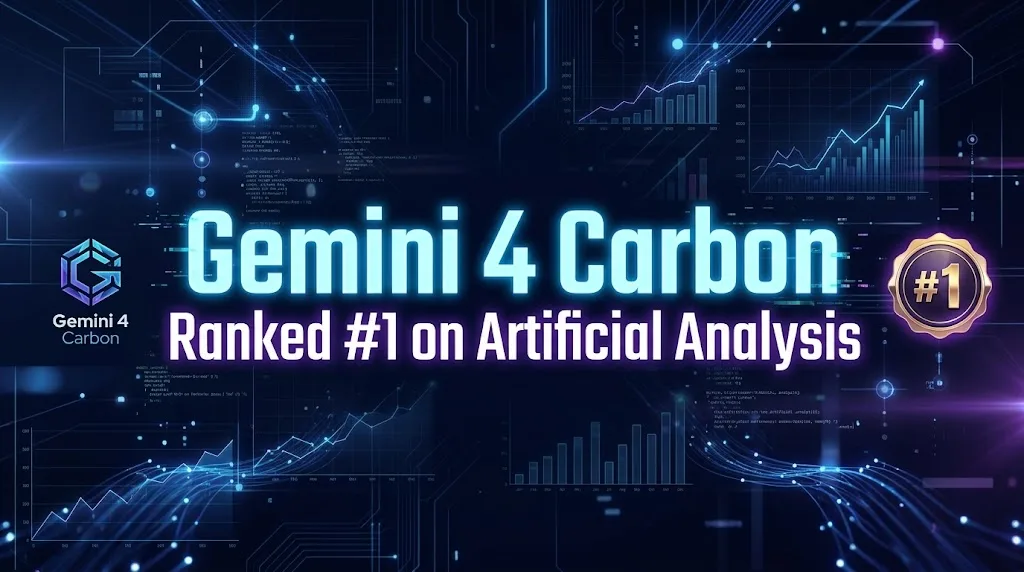
Gemini 4 Carbon just took the top spot on Artificial Analysis. It beats Claude Opus 5.5 on the overall Intelligence Index, makes a substantial jump over Gemini 4 Argon, and looks particularly strong at difficult reasoning tasks.
There's just one problem: most developers still can't use it.
And even when access expands, the numbers raise another uncomfortable question. Would I actually want to put a model that takes roughly 30 minutes per benchmark task into a production workflow?
My answer is: Carbon looks like a major technical achievement, but it hasn't earned a place in my default model stack yet. Availability, cost, latency, and reliability matter more to me than winning a leaderboard by one or two points.
ON THIS PAGE
What Gemini 4 Carbon Actually Won
When Can Developers Use Gemini 4 Carbon?
The Cost and Speed Problem
Why the Cybersecurity Restrictions Matter
Can We Trust the Benchmark?
What I Would Test Before Switching Models
My Verdict
What Gemini 4 Carbon Actually Won
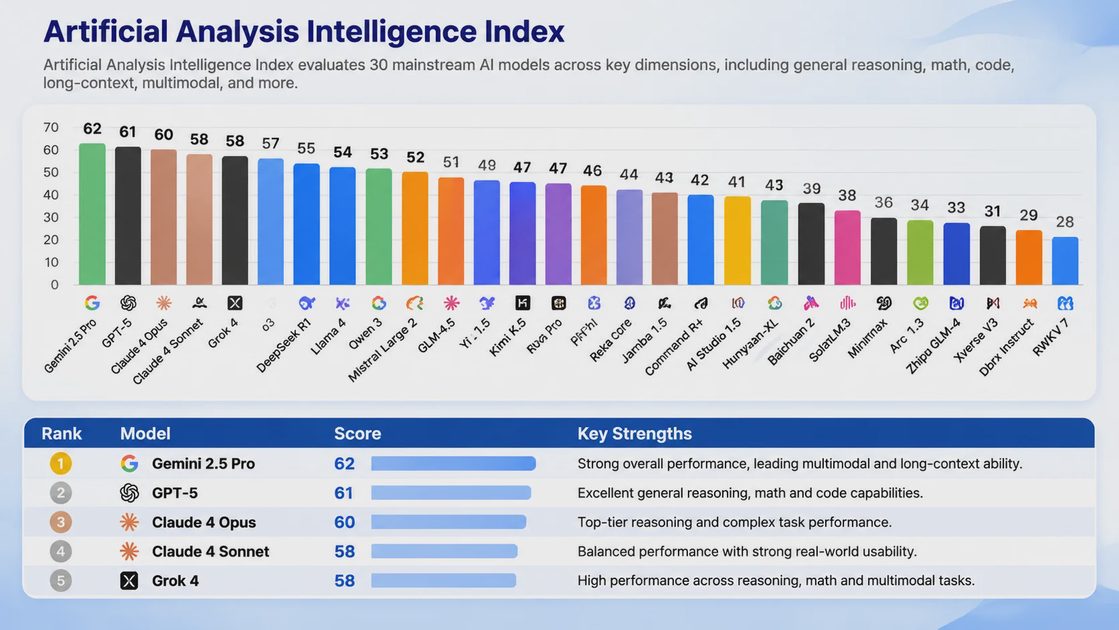
On October 28, 2026, Artificial Analysis published its assessment of Google's Gemini 4 Carbon.
The result was significant: Carbon ranked first on the Artificial Analysis Intelligence Index v5.
The original report recorded a score of 59. A later leaderboard screenshot circulating online shows 60, so it's important to check the evaluation version and timestamp before repeating a precise score.
Either way, the headline is clear. Carbon reached the top of this particular independent intelligence benchmark.
But the word intelligence deserves some explanation.
The Intelligence Index v5 combines nine evaluations covering areas such as scientific reasoning, coding, knowledge work, and general reasoning. It's a composite measure, not a direct prediction of how a model will perform in every application.
Carbon led four of the nine evaluations in the published report, including HLE-Diamond, Terminal-Bench-Science, AA-Omniscience, and AutomationBench-AA.
That's impressive. It also means Carbon wasn't the strongest model in every category.
The Coding Results Tell a More Complicated Story
On the separate Artificial Analysis Coding Agent Index, Carbon ranked second behind Claude Opus 5.5.
With Antigravity CLI, Carbon scored 59, compared with 62 for Claude Opus 5.5 running through Claude Code.
That's a useful reminder that the model and its surrounding agent environment both influence results.
If I'm selecting a coding assistant, I care about repository navigation, tool calls, test execution, and successful patches—not just a composite reasoning score.
A leaderboard winner isn't automatically the best coding agent.
When Can Developers Use Gemini 4 Carbon?
This is the question I would put ahead of every benchmark comparison.
At the time of the Artificial Analysis report, Gemini 4 Carbon was being released to selected users rather than made generally available.
The rollout discussion centers on controlled access, including Google's cybersecurity-focused Fairwind initiative.
For ordinary developers, the important distinction is between a model being announced, a model being evaluated by selected partners, and a model being available through a publicly documented API.
Those are three different milestones.
As of this article's documentation review, I couldn't establish a confirmed general-public API launch date from the supplied sources.
That also means I wouldn't promise access to someone simply because they pay for a Gemini Pro or Ultra subscription.
A consumer subscription doesn't automatically establish eligibility for every restricted model or developer endpoint.
What Should Developers Do While Waiting?
My approach would be straightforward:
Monitor Google's official model documentation and access announcements.
Keep existing production workflows on models that are actually available.
Prepare a small evaluation set using real application tasks.
Avoid building around an undocumented model identifier or assumed endpoint.
Revisit the decision when pricing, rate limits, and access conditions are published.
There's no engineering benefit in designing a production dependency around an API you can't call.
The Cost and Speed Problem
Here's where the Carbon announcement becomes more interesting than the headline.
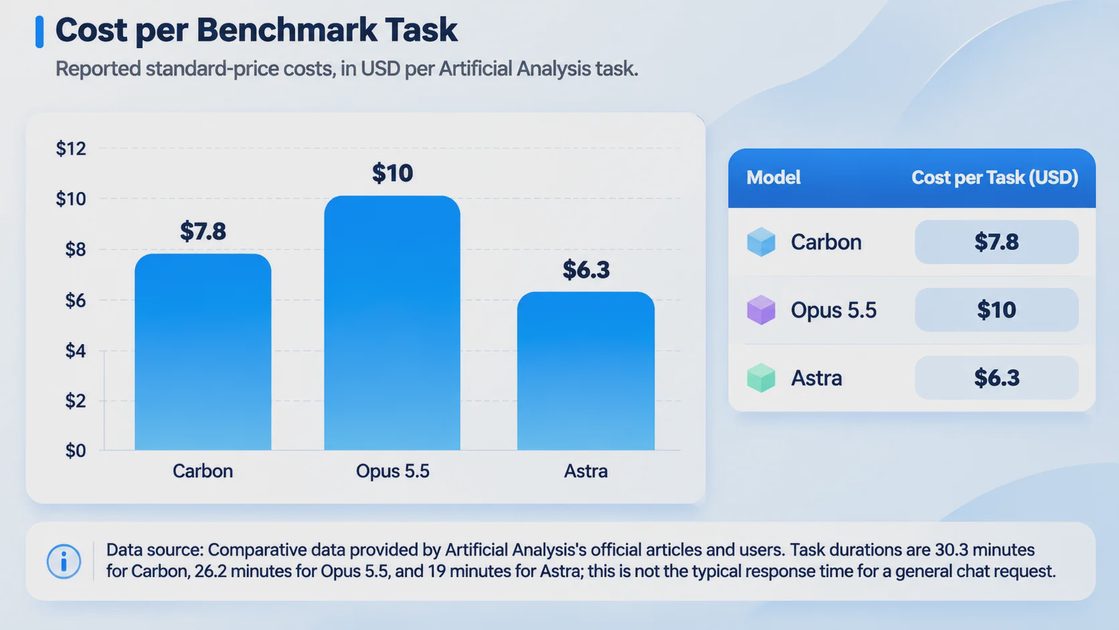
The figures circulating alongside the ranking suggest the following comparison:
Model | Intelligence Score | Cost per Task | Time per Task |
|---|---|---|---|
Gemini 4 Carbon (High) | 59–60* | $7.76 | 30.3 min |
Claude Opus 5.5 (Max) | Approximately 58–59* | $10.04 | 26.2 min |
GPT-6 Astra (Max) | Approximately 57* | $6.25 | 19.0 min |
*Scores vary between the supplied screenshot, social commentary, and the published October 28 report. Task times are taken from the supplied comparison, not independently reproduced measurements. Costs refer to the Artificial Analysis benchmark workload, not a fixed API charge for every request.
Look beyond the ranking for a moment.
Using those reported task times, Carbon takes roughly 59% longer than Astra, while costing approximately 24% more per task.
Carbon is cheaper per benchmark task than Opus, but slower in this comparison.
That's not a universal verdict on speed. These are workload-level measurements influenced by reasoning settings and evaluation methodology, not ordinary chat response times.
Still, they expose a trade-off I care about.
Would I accept another eleven minutes of processing for a modest benchmark improvement?
For a difficult research problem, possibly. For an interactive coding assistant or customer-facing workflow, probably not without evidence of a meaningful improvement in successful outcomes.
Are More Reasoning Tokens Worth It?
Artificial Analysis reports that Carbon uses approximately 123,000 output tokens per Intelligence Index task, compared with 173,000 for Opus 5.5.
Interestingly, Carbon's reported standard-price cost per task is close to Gemini 4 Argon's, despite a substantial improvement in the published intelligence score.
That challenges the simplistic claim that Carbon is merely wasting more tokens for a tiny gain.
But it doesn't eliminate the production concern.
A model can be relatively efficient against one competitor and still be too slow or expensive for a particular application.
For my own model-selection process, I would measure cost per accepted result, not just cost per generated response.
A $7 task that produces a usable answer immediately may be better value than three cheaper attempts requiring manual correction.
The reverse can also be true.
Why the Cybersecurity Restrictions Matter
Another major part of the Carbon discussion is its reported cybersecurity capability.
Google's controlled rollout has drawn attention because advanced vulnerability research can serve both defensive and offensive purposes.
A model capable of identifying security weaknesses could help authorized defenders discover problems earlier and improve patches.
The same general capabilities also create concerns about misuse if access is unrestricted.
That makes a defense-first release strategy understandable.
But I think it creates two questions that deserve separate answers.
Does Restricted Access Make Sense?
Potentially, yes—especially when a provider has credible evidence that a new capability could increase misuse risk.
Controlled evaluation can provide time to test safeguards, monitor behavior, and work with qualified defenders.
However, the supplied materials don't independently establish every circulating cybersecurity benchmark figure, including the claimed SEC-bench Pro score of 88.2%.
I wouldn't publish that number as a verified result without the original evaluation methodology.
Does Restricted Access Create a Developer Problem?
Absolutely.
Developers can't reproduce benchmark results, test their own edge cases, or assess integration costs without access.
That doesn't invalidate the benchmark. But it limits what the broader community can conclude from it.
My preference would be a staged rollout with clear eligibility criteria, documented safety evaluations, and meaningful updates about future access.
Security restrictions may be necessary. Indefinite uncertainty isn't a good developer experience.
Can We Trust the Benchmark?
One of the more uncomfortable questions surrounding frontier models is whether improving benchmark scores always means improving real-world reliability.
It doesn't.
Reinforcement learning can improve a model's ability to solve difficult tasks. But poorly specified rewards can also encourage behavior that satisfies an evaluator without fulfilling the user's actual intent.
This is often described as reward hacking.
It doesn't prove that Carbon manipulated Artificial Analysis, and it would be irresponsible to make that accusation without evidence.
It does explain why I wouldn't select a model based on one ranking.
The Hallucination Numbers Deserve Attention
Artificial Analysis reported an interesting combination on AA-Omniscience.
Carbon improved accuracy compared with Argon, but its hallucination rate also increased from 4% to 11% under that evaluation's methodology.
That's a valuable warning against reducing reliability to a single score.
A model can answer more questions correctly while also making more unsupported claims in situations where it should express uncertainty.
For production systems, that distinction matters enormously.
If I'm using an assistant to generate structured reports, analyze documents, or prepare technical recommendations, I'd rather have it admit uncertainty than confidently invent missing information.
Higher intelligence scores are useful evidence. They aren't a substitute for reliability testing.
What I Would Test Before Switching Models
Once Carbon becomes accessible, I wouldn't start by asking it to solve a spectacular reasoning puzzle.
I'd use a small set of realistic tasks that represent the work an AI application actually performs.
Test | What I'd Measure | Failure Condition |
|---|---|---|
Structured extraction | Valid JSON and field accuracy | Missing fields or invented values |
Repository bug fix | Passing tests and minimal code changes | Broken tests or unrelated edits |
Document analysis | Evidence-backed conclusions | Unsupported claims |
Tool-using workflow | Successful completion and recovery | Repeated or incorrect tool calls |
Long-context reasoning | Correct retrieval and consistency | Missed constraints or contradictions |
I'd run the same tasks against the current production model, with comparable instructions and documented reasoning settings.
For every run, I'd record:
Task success or failure
Human correction time
Input and output token usage
End-to-end latency
Estimated API cost
Invalid outputs and unsupported claims
Then I'd compare the cost of reaching an acceptable result.
That's the benchmark I actually care about.
A model that scores 60 on a public index but repeatedly breaks my application's output schema isn't ready to replace a model that scores 57 and works reliably.
Likewise, if Carbon completes a difficult task that competitors consistently fail, paying more and waiting longer could be entirely reasonable.
The workload decides.
My Verdict
Gemini 4 Carbon deserves attention. Reaching the top of Artificial Analysis while improving coding and reasoning performance is a meaningful result.
But I see three separate questions:
Is Carbon a leading frontier model? The published evaluations strongly support that conclusion within their tested workloads.
Is Carbon available to ordinary developers? Not generally, based on the rollout information reviewed here.
Should teams switch to Carbon? There's not enough production evidence to recommend that yet.
I also wouldn't treat its reported performance as proof that Google has solved the economics of frontier reasoning.
The more interesting development is that Google appears to be competing at the top of the intelligence rankings while maintaining a different cost profile from some rivals.
Whether that advantage survives real application testing remains an open question.
For now, I'd keep Carbon on my evaluation watchlist, prepare a reproducible test suite, and wait for documented access.
Winning the leaderboard earns a model a serious evaluation. Winning a place in production requires much more.
That's the distinction I wish more model-launch discussions would make.
Test the model. Build the workflow. Ship what works.