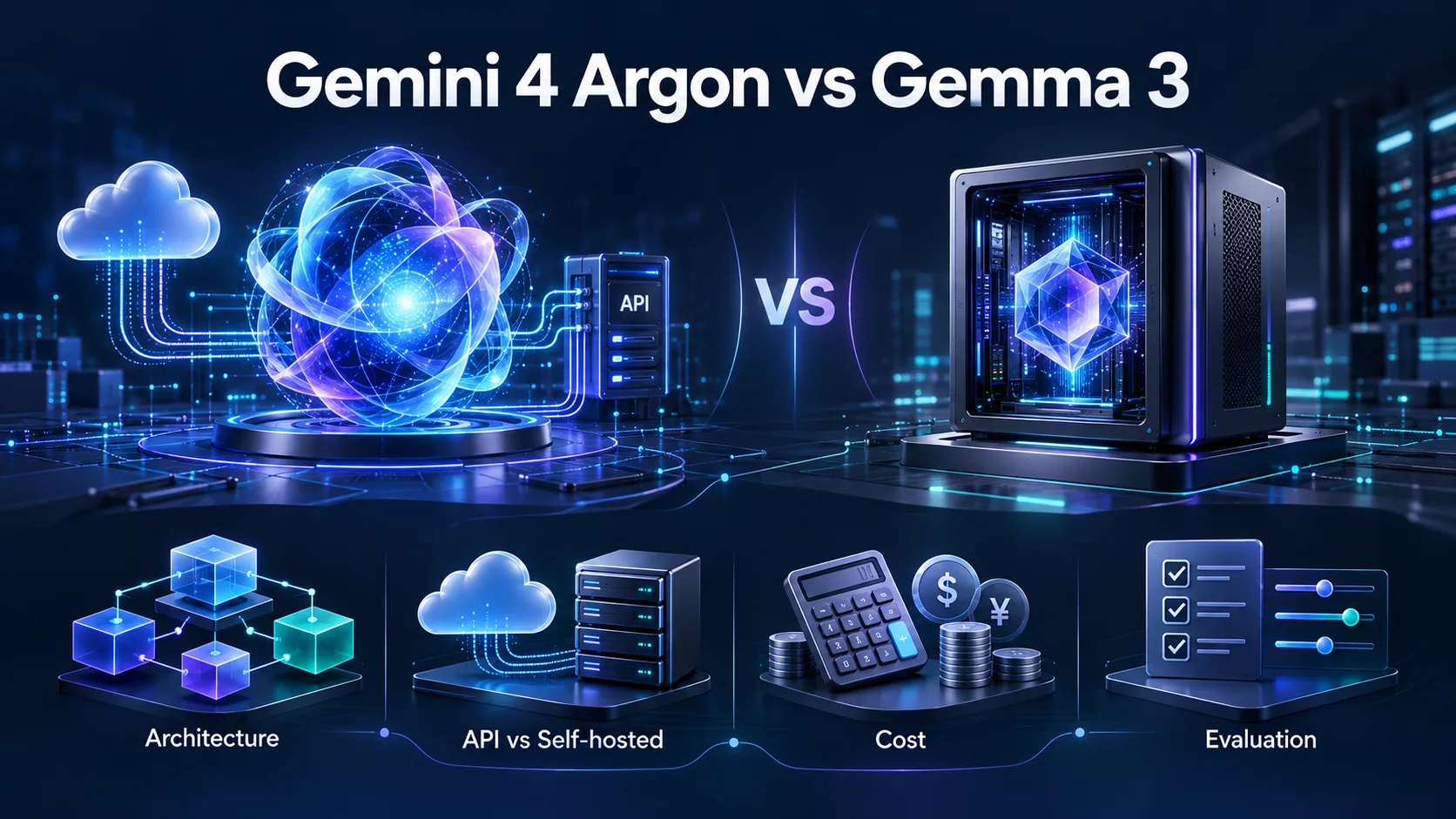
My recommendation: evaluate Gemini 4 Argon first for demanding reasoning and coding workflows where you want managed inference. Evaluate Gemma 3 12B IT first when local deployment, infrastructure control, or running model weights yourself is a core requirement.
For a small team building a complex AI feature, I would start by testing Argon’s output quality. For a team building a narrowly defined internal tool inside its own environment, I would investigate Gemma’s quality and serving requirements first.
The most important distinction is operational: Argon provides managed model access; Gemma provides downloadable weights you can deploy. That decision affects cost, maintenance, and data handling before benchmark scores enter the conversation.
The Key Differences at a Glance
Comparison | Gemini 4 Argon | Gemma 3 12B IT |
|---|---|---|
Model positioning | Flagship reasoning model for complex coding, scientific problems, and multi-step agents | Instruction-tuned, open-weight model for text generation and image understanding |
Deployment | Managed API access | Self-hosting or a hosting provider |
Local model weights | Not offered in the cited documentation | Available under Google’s Gemma usage terms |
Published context | Unified 1,048,576-token input/output window | 128K input context |
Cost model | Metered API usage | Hardware or hosting, utilization, and operations |
Main operational advantage | Provider operates inference infrastructure | Greater control over the deployed model and runtime |
What I would evaluate first | Task quality, correction effort, and API cost | Task quality, hardware requirements, and throughput |
Which Would I Shortlist?
Your main requirement | My starting choice |
|---|---|
Complex engineering or analytical work through a managed service | Gemini 4 Argon |
Running inference within your own environment | Gemma 3 12B IT |
A narrow, repetitive classification workflow | Evaluate Gemma first |
A product experiment with limited infrastructure time | Evaluate Argon first |
A workload mixing routine and difficult requests | Compare a single-model design with routing |
These are evaluation recommendations, not head-to-head performance findings.
Comparison scope: This article is based on published documentation. No comparative inference tests were performed. Cost calculations and evaluation plans are illustrative.
Why Deployment Is My First Decision
I would settle the deployment requirements before comparing small differences in model scores.
If the application must run inference inside a company-managed environment, that requirement changes the shortlist immediately. If the team wants to validate a feature without operating a model server, managed access may be the more practical starting point.
Gemma’s official repository provides deployment examples using Transformers and vLLM. Access to the model files requires acceptance of Google’s usage license.
That makes open-weight the useful description here. It should not imply unrestricted use.
I would also distinguish the model from the service hosting it. A third-party Gemma endpoint can introduce its own prices, request limits, context settings, and data-handling policies.
Choosing Gemma through a provider and running Gemma yourself are different operational decisions.
Where I Would Evaluate Gemini 4 Argon First
Argon would be my first candidate when the immediate objective is to assess a demanding workflow without also building an inference service.
Consider a fictional engineering assistant reviewing a service migration. It must reconcile requirements, examine dependencies, and explain implementation risks.
My evaluation would ask:
Does it identify the important dependencies?
Does it separate evidence from assumptions?
Are its recommendations internally consistent?
How much expert correction remains?
I would care more about those results than the confidence or fluency of the response.
For a small product team, managed inference can also keep the initial investigation focused. The team can evaluate whether the feature is useful before deciding whether operating model infrastructure is justified.
That is an architectural judgment. It does not establish that Argon outperforms Gemma on every engineering task.
What I Would Still Verify
Managed access does not remove application work.
I would inspect error handling, response parsing, request limits, and the effective model configuration. Then I would test the complete workflow, including any tools or downstream validation.
A capable model and a reliable application are separate things to establish.
Where I Would Evaluate Gemma 3 12B IT First
Gemma would move to the front of my shortlist when deployment control is essential.
Imagine an internal document-labeling service with a bounded assignment: choose one of eight categories and extract a reference number.
For that workflow, I would investigate whether Gemma meets the accuracy and throughput requirements before selecting a more elaborate architecture.
The control available through self-hosting can be useful:
Area | What I would inspect |
|---|---|
Model artifact | Exact revision and any quantization |
Runtime | Serving framework and configuration |
Infrastructure | Hardware, memory, and concurrency |
Data flow | Inputs, outputs, logs, and outbound connections |
Operations | Updates, monitoring, and recovery procedures |
I would not describe the system as private simply because the model runs locally. Telemetry, monitoring integrations, and remote resource loading still need inspection.
Control Comes With Operational Work
Self-hosting means planning for model loading, capacity, failures, updates, and monitoring.
A model producing an acceptable answer on one developer’s machine has passed an initial feasibility check. It has not established that the service can handle expected concurrency.
I would include that operational effort in the comparison from the beginning.
What the Context Numbers Mean
Argon’s documented unified window includes input, reasoning, function calls, and the final answer. Gemma’s official model card lists 128K input context for the 12B variant.
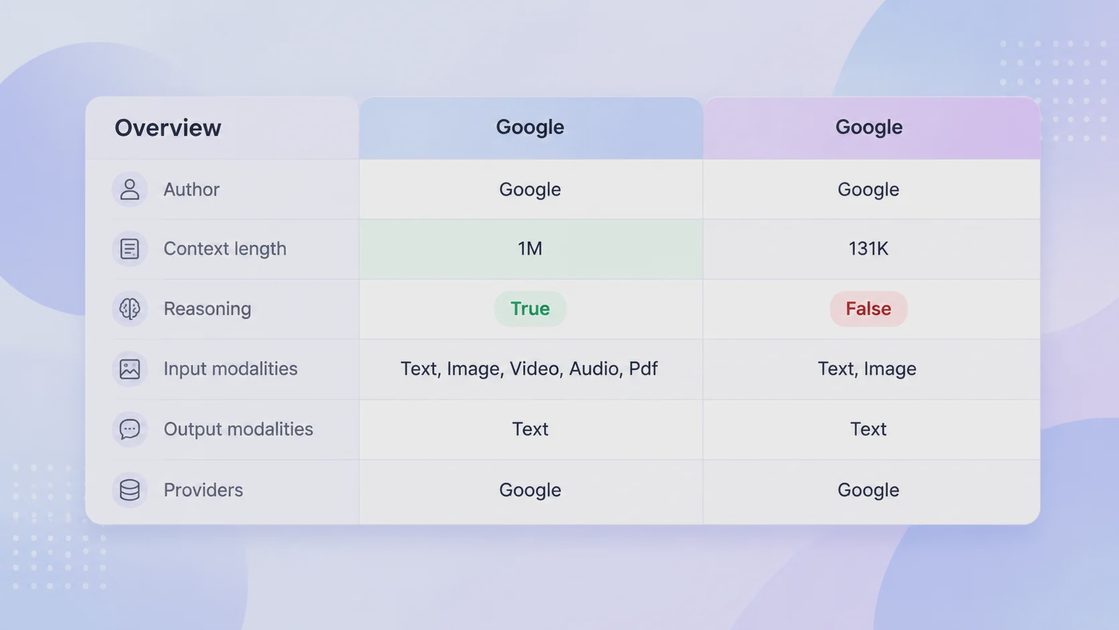
I would treat those figures as capacity specifications.
They do not prove that one model can find evidence more accurately, reconcile contradictions more reliably, or answer faster.
For document work, I would evaluate four behaviors:
Finding the relevant passage.
Preserving contradictions between sources.
Connecting findings to supporting evidence.
Acknowledging missing information.
I would also check the actual deployment. A published model capability does not mean every hosting provider or local configuration enables the same context length.
API Pricing Versus Self-Hosting Costs
Google lists the following standard Gemini Developer API prices for Argon:
Token category | Through November 30, 2026 | Starting December 1, 2026 |
|---|---|---|
Input, per million tokens | $2 | $4 |
Output, including thinking, per million tokens | $10 | $20 |
These rates are for the Developer API, not Enterprise deployments or third-party providers.
An Illustrative Argon Calculation
Suppose a workload consumes:
1 million uncached input tokens.
200,000 billable output tokens, including thinking.
At the introductory standard rates:
(1 × $2) + (0.2 × $10) = $4
At the listed December rates, the same token quantities would cost $8.
This excludes additional services and assumes the stated usage. It is not a prediction of how many tokens a particular task will consume.
How I Would Calculate Gemma’s Cost
Self-hosted Gemma has no universal per-token price.
I would calculate:

For illustration, a deployment costing $200 per month would have the following infrastructure cost:
Accepted tasks per month | Infrastructure cost per accepted task |
|---|---|
10,000 | $0.02 |
100,000 | $0.002 |
These are utilization examples, not Gemma throughput measurements. They also exclude engineering labor.
The number I would ultimately compare is cost per usable result, including failed attempts and manual correction.
How I Would Compare Actual Performance
I would prepare 30 representative cases:
Workload | Cases |
|---|---|
Classification and extraction | 10 |
Document questions requiring evidence | 10 |
Coding or analytical tasks | 10 |
This is a proposed evaluation set, not a completed benchmark.
Before generating answers, I would define acceptance criteria. Then I would record correctness, human correction effort, latency, and cost.
For Gemma, I would record the model revision, quantization, runtime, hardware, and enabled context length. For Argon, I would record the API surface, model identifier, and reasoning configuration.
The task and evidence should remain equivalent, while each model receives the formatting its integration requires.
My selection would then follow the evidence: which deployment meets the application’s quality requirements at an acceptable operational cost?