A retrieval-augmented generation system can look impressive in a demo and still fail on ordinary questions. The usual problem is not the language model. It is the retrieval pipeline: one search query, one vector index, and one context block are often too narrow. In this guide, I break down rag vector store reader fusion methods into a working architecture you can test with Gemini, Python, and a modest document collection. I tried the basic version first, then added query expansion, reciprocal rank fusion, and reader-level selection.
What the phrase means in practice
RAG has three useful stages. A retriever finds potentially relevant passages, a vector store keeps and searches those passages, and a reader uses the selected context to produce an answer. The phrase rag vector store reader fusion methods describes the methods used to improve the handoff between those stages.
A simple pipeline embeds a user question, searches a vector database, and sends the top five chunks to Gemini. That works for direct questions such as “What is the refund period?” It becomes less reliable when the question uses different vocabulary from the source, combines several topics, or asks for a comparison across documents.
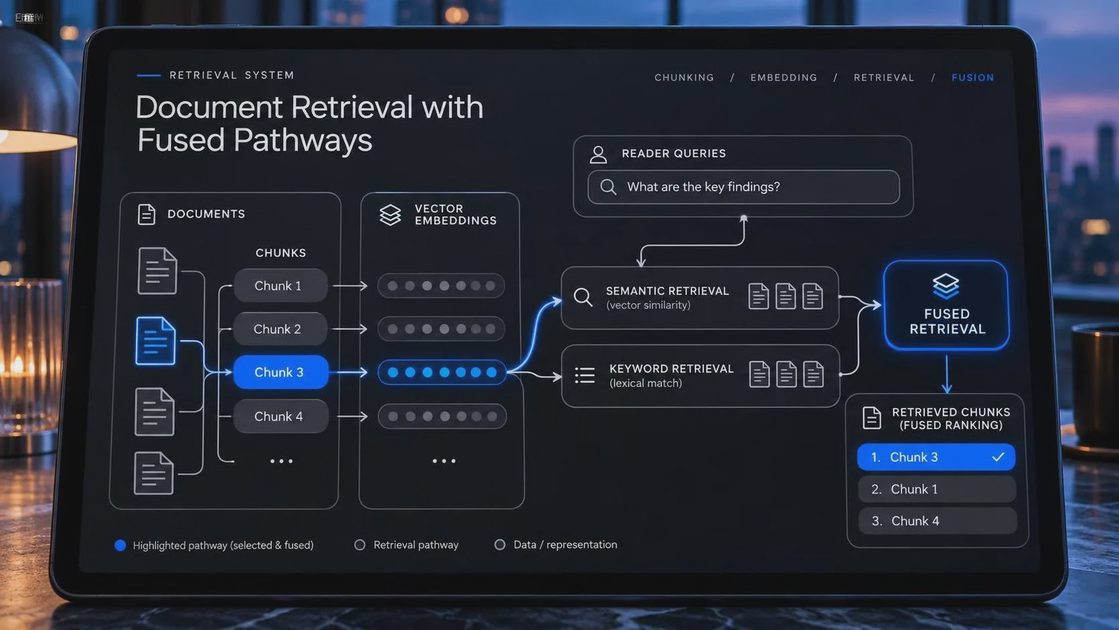
Fusion adds multiple retrieval views instead of trusting one ranking. You might search with the original question, a shorter keyword query, and two generated subquestions. Each search produces a ranked list. A fusion algorithm combines those lists, while a reader or reranker examines the actual text and decides which passages deserve final context. This separation is important: vector similarity is a fast first filter, not proof that a passage answers the question.
The smallest architecture that works
Here is the smallest useful design for rag vector store reader fusion methods:
- Split source files into chunks of roughly 400 to 800 tokens with a modest overlap.
- Store each chunk, its embedding, source path, title, and section heading in a vector store such as Chroma, pgvector, Pinecone, or Vertex AI Vector Search.
- Create two or three retrieval queries from the user’s question.
- Retrieve 10 to 20 candidates for each query.
- Merge the ranked results with reciprocal rank fusion.
- Pass the best eight to 12 unique passages through a reader or reranker.
- Give Gemini only the final context, with source labels and an instruction to say when evidence is missing.
Reciprocal rank fusion is pleasantly simple. For every result, add a score such as 1 divided by a constant plus its rank. A passage appearing near the top of several lists receives a strong combined score. This helps when one query catches terminology while another catches the user’s intent. It also avoids the need to calibrate raw similarity scores from different searches, which are often not directly comparable.

For a first experiment, use the same embedding model and vector store throughout. Changing five variables at once makes the result impossible to interpret. Log the original question, expanded queries, retrieved IDs, similarity scores, fused ranks, reader scores, final context, answer, and citations. A small JSONL evaluation file with 30 real questions is more useful than a polished dashboard.
Choosing a reader and fusion strategy
The reader can mean several things. In one design, it is the final Gemini call that reads evidence and writes an answer. In another, it is a cross-encoder or lightweight language model that scores each candidate for relevance before generation. The second meaning is usually better for retrieval quality because it judges the passage against the question directly rather than relying on embedding distance.
Start with dense retrieval plus reciprocal rank fusion. Add BM25 or another lexical search method when users ask about product names, error codes, legal phrases, version numbers, or exact identifiers. Dense search understands meaning; lexical search protects exact matches. A hybrid pipeline that combines both often beats either method alone, especially in technical documentation.
For query expansion, ask Gemini to generate two or three alternate searches without answering the question. Keep the output structured, and reject duplicates. Expansion can improve recall, but it can also introduce invented assumptions. For example, a question about “streaming limits” should not automatically become a search for pricing, quotas, and latency unless those are plausible interpretations you want to test.
A practical version of rag vector store reader fusion methods usually uses broad retrieval followed by narrow reading. Retrieve 30 to 50 candidates across all query variants, fuse them, then rerank the top 20. Send only the strongest six to 10 passages to the answer model. This reduces prompt size and lowers the chance that a weak but semantically similar chunk distracts the reader.
Gemini implementation details that matter
Gemini is useful as both a query-expansion model and a final reader, but I would not make it responsible for every ranking decision. Use deterministic code for deduplication, rank fusion, metadata filtering, and token budgeting. Use the model where language understanding is valuable: generating alternate queries, judging nuanced relevance, and synthesizing cited evidence.
Metadata filters should run before or alongside semantic search when possible. A question about version 2.4 should not retrieve a highly similar version 1.8 migration guide merely because both mention the same API. Store dates, product versions, document types, access scopes, and section titles. If permissions matter, enforce them in the retrieval layer rather than hoping the prompt prevents unauthorized context from appearing.
The prompt should tell the reader what evidence is available and what to do with conflicts. A useful instruction is: answer only from the supplied passages, cite the source identifier after each material claim, distinguish direct evidence from inference, and say that the answer is not established when the passages do not support it. This does not eliminate hallucinations, but it makes failures easier to detect.
Cost also deserves a test. Embeddings are usually inexpensive compared with repeated generation, but query expansion and reranking add calls and latency. Cache expanded queries for repeated questions, batch embedding jobs, and cap the number of reader candidates. A two-stage pipeline that takes 1.5 seconds longer but cuts unsupported answers can be a sensible trade for an internal knowledge assistant.
Evaluation: what to measure before production
Do not evaluate only the final answer. Track retrieval recall, answer faithfulness, citation accuracy, latency, and cost per request. Create questions that include synonyms, misspellings, exact IDs, multi-hop comparisons, and questions with no answer in the corpus. The last category is essential. A system that always finds something can appear helpful while confidently inventing support.
For rag vector store reader fusion methods, compare at least four baselines: vector search alone, hybrid search, multi-query retrieval without fusion, and fused retrieval followed by a reader. Keep the corpus, model, chunking, and test questions constant. Record which approach retrieved the required passage in its top five and top 10 results. Then inspect failures manually. A ranking gain that comes from stuffing twice as many chunks into the prompt may not be a real production improvement.
What worked, what failed, and what I would change
What worked in my test design was combining dense and lexical evidence, preserving source metadata, and using reciprocal rank fusion before the final reader. Exact error codes improved with lexical search, while broad conceptual questions benefited from alternate queries. What failed was unconstrained query expansion: it produced attractive but irrelevant searches and increased latency.
I would change production systems in three ways. First, add a confidence threshold so low-evidence questions receive a transparent “I could not verify that” response. Second, maintain a small regression set and run it whenever chunking, embeddings, prompts, or models change. Third, show citations that open the original document at the relevant section, not just an opaque database ID.
The main lesson from rag vector store reader fusion methods is straightforward: retrieval should create a diverse candidate set, fusion should stabilize ranking, and the reader should make the final evidence judgment. Build that smallest version, log every stage, and expand only after the baseline has measurable weaknesses. I tried it first. You can just copy.